
Anulom Vilom Pranayama: Meaning, Steps, Benefits & Precautions
Anulom Vilom Pranayama is a traditional yogic breathing practice performed by alternating the flow of breath through the two nostrils. It is commonly included in yoga and meditation practices and is valued for its gentle, rhythmic approach to breath awareness.
In this guide, we will explore the meaning of Anulom Vilom, how to practise it step by step, its traditional understanding and potential benefits, precautions, suitable practice time, and its relationship with Nadi Shodhana. The aim is to help beginners approach this breathing practice with clarity, comfort, and awareness.
Anulom Vilom: Quick Guide
- Practice: Alternate-nostril breathing
- Starting sequence: Inhale through the left nostril → exhale through the right → inhale through the right → exhale through the left
- Beginner practice: About 5 comfortable rounds
- Initial duration: Roughly 2–3 minutes
- Progression: Gradually toward 5–10 minutes as comfort and familiarity develop
- Breath retention: Not used in the beginner method described in this guide
- Breathing quality: Slow, smooth, steady, and comfortable

What Is Anulom Vilom Pranayama?
The Sanskrit term pranayama is commonly explained through prana, meaning vital energy or life force, and ayama, meaning extension, expansion, or regulation.
- Prana refers to the vital energy described in traditional Yoga teachings as sustaining life.
- Ayama can refer to extension, expansion, or regulation.
Anulom Vilom is a traditional pranayama practice in which the breath is consciously alternated between the left and right nostrils. The terms Anuloma and Viloma are traditionally understood in relation to the natural or regular order and the reverse or opposite order, reflecting the alternating direction of the breath.
How to Do Anulom Vilom Pranayama: Step-by-Step
- Sit comfortably in a meditative posture such as Padmasana, Sukhasana, or Vajrasana, keeping the spine straight and shoulders relaxed.
- Relax by closing your eyes and taking a few natural breaths.
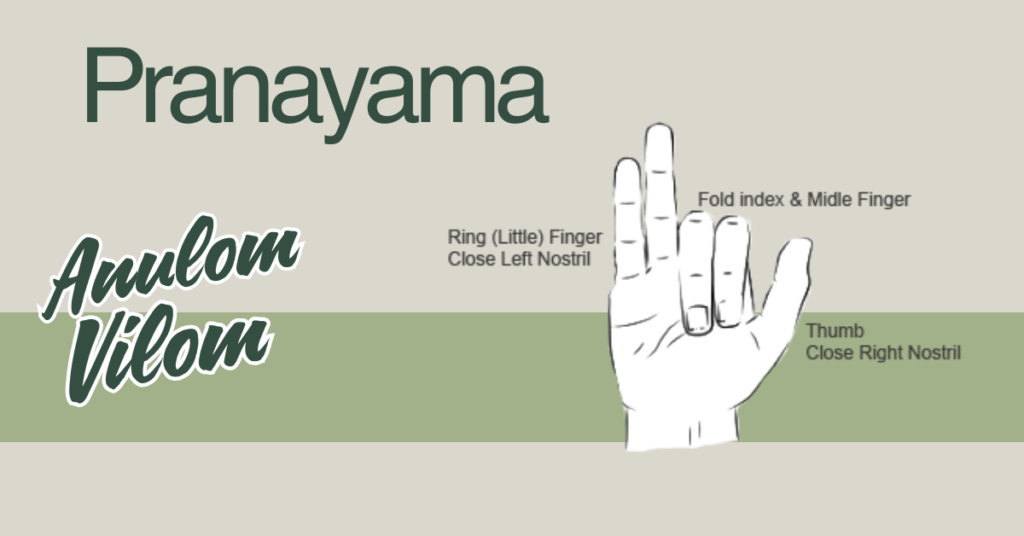
- Use your right hand in Vishnu Mudra:
- Fold your index and middle fingers toward the palm.
- Use your thumb to close the right nostril.
- Use your ring finger to close the left nostril.
Breathing sequence:
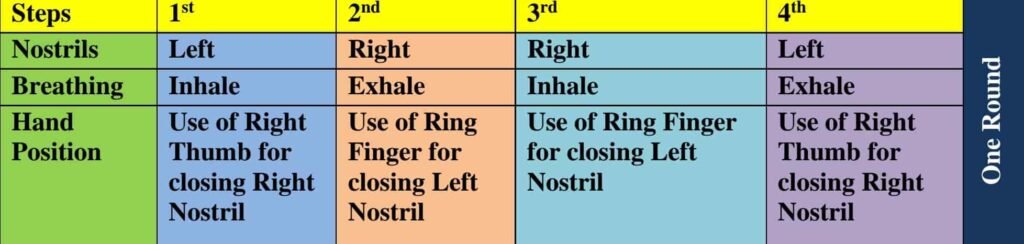
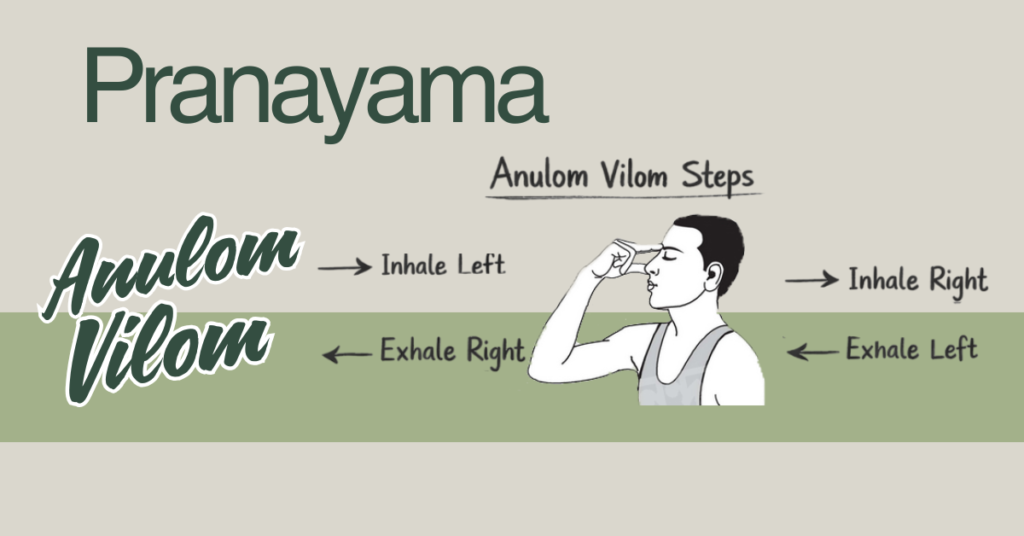
- Close your right nostril with your thumb and inhale slowly through the left nostril.
- Close the left nostril with your ring finger and exhale slowly through the right nostril.
- Inhale slowly through the right nostril.
- Close the right nostril and exhale slowly through the left nostril.
*Make Vishnu Mudra as shown in picture, Using Ring Finger and Thumb for closing the nostrils and other fingers should be folded towards the palm.
Continue at a slow, steady and comfortable pace without forcing the breath.
How much Pressure To use
Gently close the nostril. The aim is to control the airflow, not to press the nose hard.
How to Breathe During Anulom Vilom
Keep your breathing slow, smooth, and comfortable during the practice. There is no need for abnormally deep breaths or for forcing the inhalation or exhalation. Keep your face, jaw, shoulders, and abdomen relaxed, and switch nostrils gently. Unless you have learned a different method from a qualified instructor, beginners can perform this practice without intentionally holding their breath.
Common Mistakes to Avoid
- Pressing the nostrils too firmly: Use only gentle pressure when closing each nostril.
- Forcing the breath: Keep inhalation and exhalation smooth and comfortable rather than trying to breathe as deeply or quickly as possible.
- Tensing the shoulders or face: Keep the shoulders relaxed and avoid unnecessary facial tension.
- Lifting the elbow too high: Keep the arm and elbow in a comfortable position while using Vishnu Mudra.
- Rushing between nostrils: Change sides calmly and maintain an even, unhurried rhythm.
- Pushing for longer practice: Increase the duration gradually instead of continuing when the breath becomes uncomfortable.
Benefits of Anulom Vilom
Regular practice of Anulom Vilom may offer several potential benefits, although individual responses can vary and the strength of evidence depends on the breathing method, duration, and population studied.
May support stress management
Slow, controlled breathing and focused attention may help support stress management.
May support cardiovascular regulation
Alternate-nostril breathing has been associated with lower blood pressure in research, although findings vary between studies.
May support autonomic balance
Studies of Anulom Vilom have reported changes in heart-rate variability and related measures of autonomic function. Findings from a recent trial involving people with mild-to-moderate Parkinson’s disease should not be generalized to everyone.
May support aspects of cognitive and psychological well-being
A recent trial reported improvements in cognition, psychological status, and quality of life after 12 weeks in people with mild-to-moderate Parkinson’s disease. These findings do not establish the same effects in other populations.
May support aspects of respiratory function
Research on yogic breathing, including alternate-nostril practices, has reported improvements in some measures of pulmonary function. These findings involve different breathing techniques and should not be interpreted as treatment for respiratory disease.
Some findings come from studies of Anulom Vilom specifically, while others come from research on alternate-nostril or yogic breathing more broadly. Therefore, the evidence should not be assumed to apply equally to every form of the practice or to every individual.
Traditional Yogic Perspective
In traditional yoga philosophy, ‘Anulom-Vilom’ is regarded as a form of ‘Pranayama’—a technique for controlling the breath and balancing the flow of vital energy (or ‘Prana’). This method of alternating breathing between the two nostrils is traditionally associated with the subtle ‘Nadis’—or energy channels—known as ‘Ida’ and ‘Pingala’.
This practice fosters stillness and awareness, establishing a deep, mindful connection with the breath. By repeatedly focusing on the rhythm and pace of breathing, practitioners can utilize this Pranayama to cultivate concentration and prepare for meditation.
These concepts belong to the traditional philosophical and practical framework of yoga; therefore, they should not be presented as scientifically proven physiological processes. Modern research examines the potential effects of alternate-nostril breathing and yoga-based breathing techniques from a different perspective.
If you are interested in another traditional breathing practice, you can also explore Bhramari Pranayama and its step-by-step method.
What Does Research Say About Anulom Vilom?
Research on alternate-nostril breathing has examined its effects on cardiovascular, autonomic, psychological, and cognitive measures. A 2024 systematic review and meta-analysis of randomized trials found that alternate-nostril breathing was associated with reductions in systolic and diastolic blood pressure, although the researchers noted substantial variation between studies.
Research specifically involving Anulom Vilom has also reported changes in heart-rate variability and blood-pressure measures. A recent randomized controlled trial studied Anulom Vilom as an adjunct to conventional treatment in people with mild-to-moderate Parkinson’s disease and reported improvements in cardiac autonomic measures, cognition, psychological status, and quality of life after 12 weeks.
These findings are encouraging, but they do not mean that Anulom Vilom treats or prevents disease. Research differs in breathing techniques, duration, participants, and study design, so the results should be interpreted as evidence of possible supportive effects rather than guaranteed health outcomes.
Who Can Practice Anulom Vilom?
Anulom Vilom can be practised by many beginners as part of a gentle yoga or breathing routine. Start with a comfortable, natural breathing rhythm rather than trying to control the breath forcefully.
Who Should Be Cautious?
Anulom Vilom is generally gentle when practised without force or prolonged breath retention. If you are pregnant or have a respiratory or cardiovascular condition, severe hypertension, or another health concern affecting breathing, consider consulting a healthcare professional and a qualified Yoga teacher before starting. If your nose is completely blocked by a cold or acute sinus infection, consider waiting until normal nasal breathing returns. Stop the practice and return to normal breathing if you experience dizziness, breathlessness, chest discomfort, pain, or unusual discomfort.
When Is the Best Time to Practice?
Many practitioners prefer morning practice, while others find an evening session more suitable. Choose a time when you can practise comfortably and without rushing.
For comfortable practice, avoid doing Anulom Vilom immediately after a heavy meal. Choose a time when you can sit comfortably without rushing or interruption.
How Long Should You Practice Anulom Vilom?
For beginners, start with about 5 comfortable rounds, which may take roughly 2–3 minutes. As you become familiar with the technique, you can gradually increase the practice toward 5–10 minutes, provided the breathing remains relaxed and comfortable. There is no need to increase the duration quickly; maintaining a relaxed, steady breathing pattern is more important than practising for a longer time.
For beginners, practicing regularly every day can be more beneficial than practicing for long periods only occasionally. Start with a single, comfortable session a day and gradually build a consistent routine. When practicing frequently, ensure that each session remains steady and relaxed rather than overly intense.
If the practice causes dizziness, breathlessness, or discomfort, stop and return to normal breathing.
Is Anulom Vilom the Same as Nadi Shodhana?
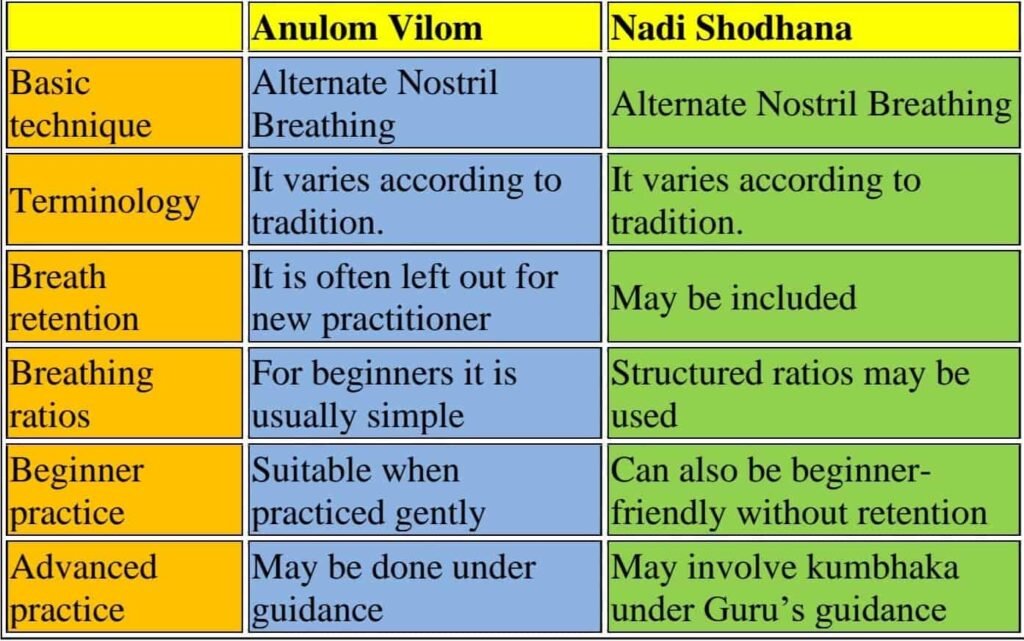
Anulom Vilom and Nadi Shodhana are closely related terms for alternate-nostril breathing, but their exact usage can vary between yoga traditions and teaching systems.
In some modern yoga guides, Anulom Vilom refers to alternating the breath between the two nostrils without deliberate breath retention, while Nadi Shodhana may be taught with breath retention and specific breathing ratios.
However, this distinction is not universal. The Ministry of Ayush uses Nadi Shodhana or Anuloma-Viloma Pranayama together when describing alternate-nostril breathing.
For this article, we use Anulom Vilom to describe the gentle alternate-nostril practice without deliberate breath retention, making it suitable as a simple starting point for beginners.
Variations of Anulom Vilom
‘Anulom-Vilom’ is taught in slightly different ways across various yoga systems and schools of thought. While the core principle—alternately inhaling and exhaling through the two nostrils—remains consistent, variations may exist depending on the instructor regarding the breathing sequence, the duration of inhalation and exhalation, and whether breath retention (*Kumbhaka*) is included.
For beginners, practicing the technique without breath retention can be a practical way to become familiar with the fundamental pattern of alternate-nostril breathing. More structured practices involving breath retention or specific breathing ratios are better learned from an experienced yoga instructor rather than incorporated independently.
Anulom Vilom in Traditional Yoga
In traditional Yoga, pranayama occupies an important place within the broader yogic path. Anulom Vilom is practised within this traditional framework as a form of pranayama and is commonly incorporated into practices involving concentration and meditation.
Pranayama in Patanjali’s Ashtanga Yoga
In Patanjali’s Ashtanga Yoga, pranayama is the fourth of the eight limbs, following asana and preceding pratyahara, dharana, dhyana, and samadhi.
- Yama (ethical restraints)
- Niyama (personal observances)
- Asana (postures)
- Pranayama (breath regulation)
- Pratyahara (withdrawal of senses)
- Dharana (concentration)
- Dhyana (meditation)
- Samadhi (self-realization)
Within this framework, pranayama marks a movement from the physical practice of asana toward more inward practices such as sense withdrawal and concentration.
Is Pranayama Necessary for Meditation?
Pranayama can be a useful preparation for meditation. In traditional yoga practice, breath regulation is used to encourage steadiness and greater awareness, which may help create a more settled state for meditation. However, pranayama is not a prerequisite for everyone, and meditation can also be practised directly through other approaches.
Ida and Pingala in Yogic Tradition
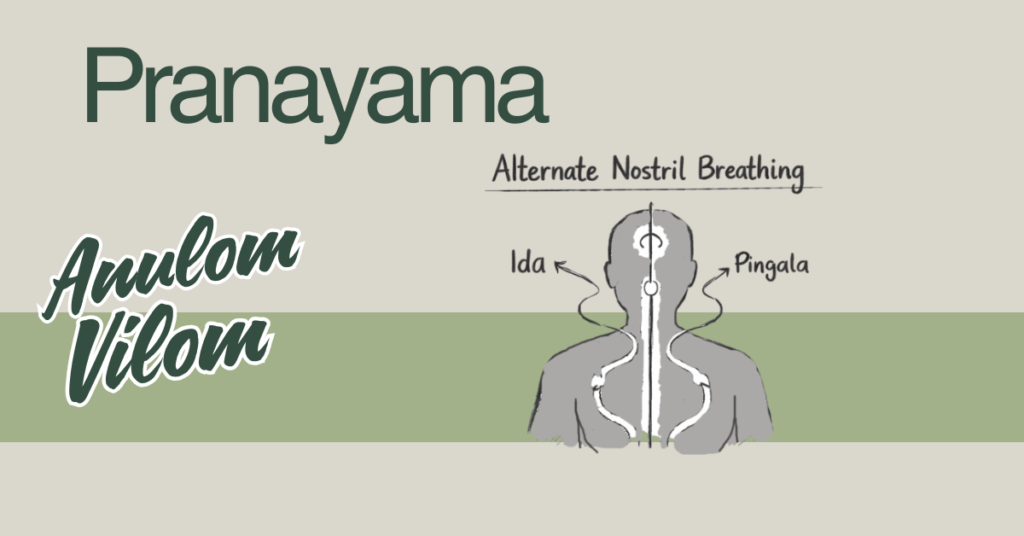
In traditional yoga philosophy, alternate nostril breathing is also associated with the Ida and Pingala Nadis. Ida is traditionally linked with the left side and a calming, cooling quality, while Pingala is associated with the right side and an energizing, warming quality. These are concepts within the yogic energetic framework rather than established medical anatomy.
History and Origins of Pranayama
Pranayama was not created by a single individual. It developed over centuries within Indian yogic traditions. Patanjali later incorporated pranayama into the eight-limbed framework of yoga, while later Hatha Yoga texts described specific breathing practices in greater detail.
Frequently Asked Questions About Anulom Vilom
Can beginners practise Anulom Vilom every day?
Yes. Beginners can practise it regularly as long as the breathing remains smooth and comfortable. They may start with a short session and gradually develop a consistent routine rather than trying to practise for a long period from the beginning. If you experience dizziness, breathlessness, or discomfort, stop and return to normal breathing.
How many rounds of Anulom Vilom should I practise?
There is no single number of rounds that suits everyone. Beginners can start with a few comfortable rounds and gradually increase them as the technique becomes familiar.
Can I Practise Anulom Vilom After a Meal?
It is best to practise Anulom Vilom when your stomach feels comfortable. After a full meal, allow sufficient time for digestion before beginning the practice. If you feel heavy or uncomfortable, wait until you feel ready. If you have eaten only a light snack, practise only when you feel comfortable.
Can I practise Anulom Vilom before sleeping?
Yes. Anulom Vilom can be included in an evening relaxation routine. Keep the breathing gentle and avoid forcing the breath.
Can I practise Anulom Vilom without breath retention?
Yes. The practice described in this article uses alternate inhalation and exhalation without deliberate breath retention. This is also the form used in a recent randomized controlled trial of Anulom Vilom.
Which Nostril Should I Start With?
To begin the basic technique described in this guide, first inhale slowly through the left nostril and then exhale through the right nostril. Next, continue the process by inhaling through the right nostril and exhaling through the left. As this technique may have variations across different yoga methods and practices, please follow the specific instructions provided by your instructor when practicing a particular method.
What If One Nostril Is Blocked?
Do not try to force a breath through a blocked nostril or apply excessive pressure on the nose to create airflow. If one nostril is significantly blocked, wait until breathing becomes natural and comfortable. If you can breathe easily through the other nostril, refrain from forcing the switch to follow the alternate-nostril breathing sequence.
Conclusion
Anulom Vilom is a simple traditional breathing practice that can be incorporated into a mindful yoga routine. Practising it with a relaxed, steady breath may help develop greater awareness of breathing and create a calm space for reflection. Rather than forcing the breath or aiming for a particular result, focus on comfort, consistency, and attentive practice.
About the AuthorYogacharya Dhruv Ji is a Yoga Teacher and practitioner committed to preserving and sharing the authentic wisdom of traditional Yoga and Kriya Yoga. Dhruv Ji received his training in Yoga and Kriya Yoga under the esteemed guidance of Swami Birajananda Giri Maharaj, a revered spiritual teacher known for his deep understanding of yogic philosophy, meditation, and the ancient practices of self-realization. |
Disclaimer
The information provided here is intended to help readers understand Anulom Vilom and its practice. It is not intended to diagnose, treat, or prevent any medical condition, nor does it replace advice from a qualified healthcare professional. If you have a medical condition, are pregnant, or have concerns about practising Anulom Vilom, consult your healthcare provider before beginning. Practise gently and stop if you experience pain, dizziness, breathlessness, or unusual discomfort.