
Bhastrika Pranayama: Benefits, Steps, Types and Precautions
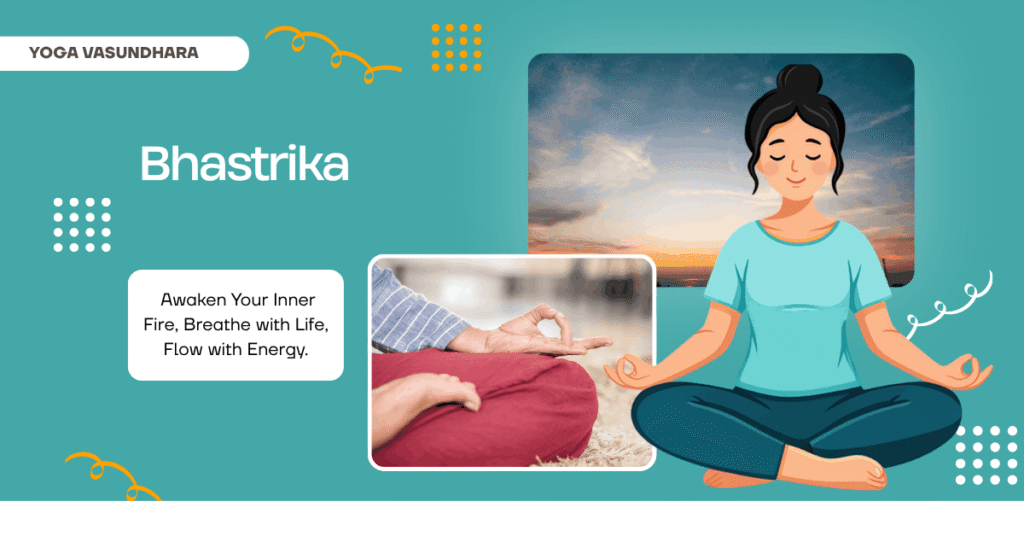
Understanding Bhastrika Pranayama Beyond Fast Breathing
Breathing usually happens without conscious attention. In pranayama, however, the breath becomes an intentional part of the practice. Bhastrika Pranayama is a traditional yogic breathing technique in which both inhalation and exhalation are active.
The name comes from the Sanskrit word bhastra, meaning a bellows. This comparison reflects the repeated movement of air during the practice, which is why Bhastrika is commonly known as Bellows Breath.
Although Bhastrika is often associated with vigorous breathing, speed alone does not define the technique. The method, rhythm and level of effort can vary between yoga traditions. Beginners should first learn the movements correctly rather than trying to breathe rapidly or forcefully.
At Yoga Vasundhara, pranayama is approached as a practice of awareness, appropriate effort and steady learning. Guidance from an experienced yoga teacher can help practitioners understand the technique and recognise when a gentler approach is more suitable.
This guide covers the meaning of Bhastrika Pranayama, its potential benefits, step-by-step instructions, differences from Kapalbhati, practice duration and important precautions.
What Is Bhastrika Pranayama?
Bhastrika is a breathing discipline practised in traditional yoga. During the exercise, the practitioner consciously draws air in and releases it out, repeating the two movements in a controlled sequence.
The breathing rhythm depends on the particular method taught by the yoga instructor.
The way Bhastrika is taught can differ between yoga schools. Some methods use a more vigorous rhythm, while others place greater emphasis on a measured pace. For a beginner, learning the correct technique matters more than matching someone else’s speed.
Practise within your comfort level and learn the method from a qualified yoga teacher, especially if you are unfamiliar with forceful breathing exercises.
Types of Bhastrika Pranayama
The instructions for practising Bhastrika can differ depending on the teacher and the yoga lineage. Teachers may use different breathing rhythms, levels of intensity and stages of progression. Follow the specific technique demonstrated by your instructor, since the steps and breathing rhythm may vary between methods.
- Gentle, Controlled Bhastrika
Beginners can start with a comfortable breathing pace and develop control before attempting a faster rhythm. The practitioner maintains an even, manageable rhythm and avoids straining the chest, abdomen or facial muscles. This approach can help beginners become familiar with the technique under appropriate guidance.
- Traditional Rhythmic Bhastrika
In some traditional teaching methods, inhalation and exhalation are performed actively in a repeated pattern. The pace depends on the method being taught and the practitioner’s experience. The goal is to coordinate the breathing movement rather than compete for speed.
- More Vigorous Bhastrika
Some yoga schools teach a stronger, faster version to experienced practitioners. Because vigorous breathing may cause lightheadedness or other discomfort, it should not be treated as the default method for beginners. Learn it only with suitable instruction and follow the teacher’s guidance on pace, duration and rest.
These descriptions are practical ways to understand differences in teaching intensity; they are not a universally recognised list of three formal types. If your yoga lineage uses specific names or a distinct sequence, describe those methods according to your teacher’s instructions.
What Is Bhastrika Pranayama Also Known As?
Bhastrika is commonly known in English as Bellows Breath, a name inspired by the repeated movement of air. The traditional name is still widely used in yoga instruction.
It should not be confused with every other breathing exercise that uses vigorous inhalation or exhalation. Different pranayama techniques have distinct methods, rhythms and purposes.
How to Do Bhastrika Pranayama Correctly
Learning the movement matters more than increasing the speed. Begin with a calm, comfortable breathing pattern and practise under the guidance of a qualified yoga teacher if you are unfamiliar with pranayama.
Step 1: Choose a suitable place
Choose a setting where you can concentrate on the exercise and stop whenever necessary. Postpone the session if strenuous activity has left you panting or you have not yet recovered your normal breathing.
Choose a stable surface and make sure the room is comfortably ventilated.
Step 2: Sit in a steady position
Sit cross-legged on a mat if that position is comfortable for you. You may also sit on a firm cushion or chair, provided your back is supported by your own posture rather than slumping forward.
Maintain an upright but relaxed posture, let your shoulders soften, and rest your hands comfortably on your thighs.
There is no need to force yourself into Padmasana or another demanding seated posture. Comfort and stability are more important than the appearance of the pose.
Step 3: Settle your breathing
Close your eyes gently if that feels comfortable, or keep your gaze lowered.
Take a few ordinary breaths. Notice whether your face, jaw, neck and shoulders are relaxed. Do not deliberately take unusually deep breaths at this stage.
This brief pause helps you establish a comfortable starting point.
Step 4: Begin with a gentle inhalation
Breathe in actively but comfortably through your nose. Let your torso respond to each breath without deliberately exaggerating its movement or stiffening your upper body.
Avoid lifting your shoulders sharply or tightening your neck to pull in more air.
Step 5: Exhale actively
Release the air through your nostrils using the active outward phase taught in your chosen Bhastrika method.
In Bhastrika, both phases of breathing are deliberately engaged. Follow the inhalation and exhalation pattern demonstrated by your instructor rather than relying on forceful outward breaths alone.
Do not squeeze the abdomen excessively or push air out until your lungs feel completely empty.
Step 6: Establish a controlled rhythm
Continue with a small number of comfortable breathing cycles. Keep the movement coordinated and avoid trying to match the speed of another practitioner.
If your breathing becomes uneven, your face tightens or you feel the urge to gasp, slow down or stop.
Step 7: Finish and allow your breathing to settle
After completing the round, stop the deliberate breathing movements and return to natural breathing. Take a quiet pause before moving on, and resume your usual activities only when you feel recovered.
Do not start another round while you feel unwell. End the exercise if you become lightheaded, struggle to breathe normally, or notice any unexpected symptoms.
Beginner’s principle: If you cannot maintain a relaxed posture and a controlled rhythm, the practice is too demanding for you at that moment.
Starting Bhastrika: Choosing a Suitable Number of Rounds
There is no single round count that suits every beginner. A suitable workload must account for the particular technique being taught and whether the practitioner can perform it without discomfort.
In a guided beginner session, the instructor can introduce a brief sequence, pause to assess the student’s response and adjust the next attempt accordingly. The number of cycles should be increased only when the technique remains comfortable and controlled.
A beginner should not assume that completing a large number of repetitions will produce better results. More vigorous breathing can increase the chance of dizziness, tingling, discomfort or excessive strain.
Adjusting Your Bhastrika Practice:
- Start with a small amount of active breathing rather than a long continuous session.
- Rest between rounds and allow your breathing to return to normal.
- Only add more breathing cycles when you can perform the current sequence comfortably and maintain the technique your instructor has taught you.
- Stop if you experience dizziness, unusual breathlessness, chest discomfort or visual changes.
- Learn the version taught by your instructor before attempting faster variations.
If you are completely new to pranayama, a qualified teacher can help you determine whether Bhastrika is an appropriate starting technique. Gentle awareness of natural breathing may be a better first step.
How Many Minutes Should You Practise Bhastrika Pranayama?
The length of a Bhastrika session should be decided according to the method being practised and the individual’s ability to tolerate it, rather than a fixed time goal.
A short, supervised introduction is generally more sensible than immediately attempting an extended session. At the learning stage, pay attention to the coordination of inhalation and exhalation. For now, practise the breathing sequence your instructor has demonstrated; add more cycles only when you can perform it without straining.
It is also important to distinguish between active breathing time and the total time spent on the exercise. A session may include settling into the posture, short breathing rounds, rest periods and quiet observation afterward.
A five-minute session that includes pauses is not necessarily equivalent to five minutes of uninterrupted vigorous breathing.
Published studies have investigated Bhastrika under different conditions. The studies used different approaches: one followed participants through a month-long Bhastrika programme, whereas the other recorded short-term physiological changes after a single slow-breathing session.
Because researchers used particular breathing protocols and participant groups, the results cannot establish what every practitioner will experience with a different technique.
For your personal practice, follow the duration recommended by a qualified instructor who understands your experience and health circumstances. Do not extend the session because you feel you should be doing more.
Can You Practise Bhastrika Pranayama Every Day?
Daily practice may be appropriate for some healthy, experienced practitioners who have learned a suitable technique. However, it is not necessary for every person, and daily vigorous breathing is not automatically better than a shorter or less frequent practice.
Before making Bhastrika part of your routine, consider three things:
Technique: Can you maintain the intended breathing pattern without tightening your face, neck or shoulders?
Response: Do you finish comfortably, without dizziness, headache, unusual breathlessness or other symptoms?
Suitability: Have you considered any health conditions or medicines that might make forceful breathing unsuitable?
Before making Bhastrika part of your routine, learn its breathing pattern from a qualified teacher. Depending on your experience and health, the teacher may recommend a gentler version or a different breathing exercise.
If symptoms occur during a session, stop instead of trying to build tolerance by pushing through them. Arrange a medical assessment if the discomfort continues after you stop practising or returns whenever you attempt the exercise.
What Is the Best Time to Practise Bhastrika?
You can schedule Bhastrika around the part of your day when you have enough time and energy to practise attentively. A morning routine may be convenient, but another time can work if you are comfortable and free from distractions.
Your schedule does not have to follow a fixed hour. Choose a time that allows you to practise attentively and maintain a routine that suits your daily life.
Consider these practical points:
- Choose a time when you are alert and can practise without rushing.
- Avoid vigorous breathing immediately before sleep if you find that it makes you feel more alert.
- Do not practise when you are overheated, exhausted, breathless or feeling unwell.
- Allow yourself enough time to settle afterward instead of moving straight into strenuous activity.
Morning practice may suit some people, but comfort, consistency and appropriate technique should guide your choice.
Should Bhastrika Pranayama Be Done on an Empty Stomach?
It is generally more comfortable to practise vigorous pranayama when you are not digesting a large meal. A full stomach can make forceful breathing uncomfortable. Schedule Bhastrika away from a heavy meal. If your stomach still feels full or uncomfortable, wait until that sensation has passed before starting.
Feeling faint, shaky or unusually weak is a reason to skip the session. Address the cause of those symptoms first instead of attempting vigorous breathing.
If hunger leaves you weak or shaky, eat as appropriate and wait until you feel comfortable before considering the practice.
People with diabetes or other conditions that affect blood sugar should be especially mindful of feeling faint or weak. Anyone managing a medical condition should check with their treating clinician about whether vigorous breathing is suitable alongside their existing care plan.
What Are the Benefits of Bhastrika Pranayama?
Bhastrika is described in traditional yogic teachings, while modern research is still examining its effects. Claims about particular health outcomes should reflect the strength and limitations of the available evidence.
The effects of a breathing technique depend on how it is performed, how often it is practised and the individual performing it.
Some potential benefits are related to the experience of practising with attention. Others have been investigated in small research studies. Neither traditional use nor early research means that every claimed effect has been firmly established.
- Greater awareness of breathing
Bhastrika requires deliberate attention to inhalation and exhalation. Practising with care can help a person notice habits such as shallow breathing, unnecessary muscular tension or rushing through each breath.
This is a practical skill that can carry over into other breathing exercises. It does not mean that the practice corrects every breathing problem or replaces assessment for respiratory symptoms.
- A structured period of concentration
Maintaining the sequence requires attention to the timing of each inhalation and exhalation, which makes the breathing technique an exercise in focused awareness.
Posture and a steady rhythm also help the practitioner follow the sequence with care.
Some people find that this creates a useful pause in an otherwise busy day. The experience will vary, and a slower practice may be more suitable for someone who finds active breathing distracting or uncomfortable. Read the 2020 Bhrastika Pranayama Study.
- What Bhastrika Research Suggests About Emotional Wellbeing
A 2020 study investigated a four-week Bhastrika training programme in 30 healthy young adults. The researchers reported improvements in measures related to state anxiety and negative affect, alongside exploratory findings involving brain activity and connectivity.
The findings offer an early indication of how Bhastrika training might relate to emotional state. Further studies involving larger and more diverse groups are needed before its role in anxiety care can be established.
If anxiety continues to affect everyday life, seek advice from a qualified healthcare professional. Yoga may complement recommended care when it is suitable for the individual. If vigorous breathing causes discomfort, consider a gentler practice instead.
- An opportunity to develop breathing control
Learning a specific breathing technique involves coordinating the respiratory movement with attention and posture.
Becoming more familiar with controlled breathing does not, by itself, demonstrate that lung function has improved or that a respiratory condition has been treated. Such outcomes require appropriate measurements and stronger evidence.
- Where Bhastrika Fits Into Your Yoga Practice
A yoga instructor may introduce Bhastrika into a session after considering the student’s familiarity with pranayama and ability to manage active breathing. A session can also draw on slow-paced stretches, periods of stillness, comfortable resting positions or breathing techniques that require less effort.
There is no requirement to practise every pranayama technique. Choosing an appropriate practice is more important than collecting a long list of techniques.
Bhastrika Pranayama and Brain Health: What Research Shows
Questions about Bhastrika and the brain often arise because breathing is connected with the body’s automatic regulation systems and because pranayama research sometimes measures brain activity.
To assess claims about Bhastrika and the brain, it helps to distinguish measured research outcomes from explanations that have yet to be confirmed.
Attention and mental engagement
Following a deliberate breathing rhythm requires concentration. The exercise calls for attention to the timing of each breath, the stability of the seated position and any signs that the breathing has become strained.
Learn the technique at a pace you can manage, and keep each breathing movement comfortable rather than hurried.
The concentration involved in the exercise should not be taken as evidence that it enhances memory, raises intelligence or improves academic results.
Research on brain activity
Research on Bhastrika and brain activity remains preliminary. The available findings are not enough to establish lasting changes in brain structure or protection against neurological illness.
These observations provide starting points for further investigation, but they do not demonstrate that practising Bhastrika changes brain anatomy over time or protects against neurological illness.
Because only a limited group of participants was studied, it remains uncertain whether similar outcomes would occur among people of different ages or health backgrounds.
Stress and mental state
The immediate response to Bhastrika varies. One person may experience increased alertness, whereas another may develop discomfort when the breathing becomes too rapid or forceful.
The effect depends on the individual and the way the exercise is performed.
If your primary aim is to settle an agitated mind, a slower breathing practice or meditation may be more appropriate than vigorous Bhastrika.
A realistic conclusion: Bhastrika is worth studying as a breathing practice with possible psychological and physiological effects. It should not be marketed as a proven treatment for brain disorders or as a guaranteed way to increase intelligence.
What Is the Difference Between Kapalbhati and Bhastrika Pranayama?
In commonly taught Bhastrika, inhalation and exhalation are both active parts of the exercise. In Kapalbhati, the exhalation is usually deliberate and active, while inhalation occurs more passively. Their traditional techniques, however, are not identical.
The precise teaching method may differ between yoga traditions, so this comparison describes commonly taught forms rather than every variation.
Neither technique is automatically superior. The appropriate choice depends on your experience, health, purpose and the instruction you have received.
If you are learning both, practise them separately until you understand the mechanics of each. Trying to combine their movements can make the technique confusing.
Which Pranayama Is the Most Powerful?
There is no scientifically established ranking that identifies one pranayama as the most powerful for every person.
The word powerful can mean several different things. Someone may use it to describe a vigorous breathing action, a calming experience, improved concentration or a technique that is challenging to learn. These are not the same outcome.
Unlike techniques that emphasise only one part of the breath, Bhastrika actively involves both drawing air in and pushing it out.
Kapalbhati has a different emphasis, while slow breathing practices such as Nadi Shodhana are often approached with a more measured rhythm. Bhramari uses humming during exhalation and offers a different sensory experience.
Intensity alone is not a reliable measure of a pranayama technique’s value. Anyone who finds strong respiratory movements uncomfortable may find a slow, gentle pranayama technique easier to manage.
Start by deciding what you want from your breathing practice, then choose a method that suits that purpose. Consider the following differences:
- If you are learning to observe your breath, begin with simple breathing awareness.
- For those interested in Bhastrika, learning the breathing pattern from an experienced yoga teacher is a sensible starting point.
- When a high-energy breathing method feels unsuitable, an instructor can help you identify a practice that better matches your comfort level.
- If you have a medical condition or experience symptoms during breathing exercises, seek individual advice before choosing a technique.
Before beginning, explain to your yoga instructor what breathing exercises you have tried and whether any of them have caused discomfort. They can use this information to help you choose an appropriate practice.
Why Can Bhastrika Pranayama Cause Dizziness or Lightheadedness?
At the first sign of near-fainting, stop the practice and sit or lie down securely until you feel stable.
Breathing beyond your needs can reduce carbon dioxide levels in the bloodstream. Excessive ventilation may bring on tingling sensations, difficulty keeping your balance or a feeling that you are about to black out. Leave the practice for the day if the symptoms have not settled.
Lightheadedness may also be linked to inadequate hydration, fluctuations in blood pressure or glucose, side effects of medicines, or another medical problem. It should not automatically be attributed to pranayama.
Fainting, chest pain or major breathing problems warrant emergency medical care. If less severe symptoms continue or happen again, arrange an assessment with a healthcare professional.
Common reasons for discomfort
Breathing too quickly: Increasing the pace beyond your current ability may disrupt comfortable breathing.
Using too much force: Strong muscular effort can create tension and make the exercise difficult to control.
Continuing without rest: Repeated rounds without adequate pauses may increase discomfort.
Starting while unwell: Fatigue, illness, dehydration or feeling faint beforehand can make the practice unsuitable.
Holding the breath unnecessarily: Adding breath retention when it has not been taught or assessed for your circumstances can increase the difficulty of the exercise.
How to Respond to Dizziness During Practice
Stop the active breathing immediately.
Return to gentle, ordinary breathing without taking repeated, oversized breaths.
Sit or lie down somewhere safe to reduce the chance of falling.
Do not resume Bhastrika during that session.
Seek medical assessment if you do not recover promptly, the symptoms return, or you are concerned about what happened.
Get emergency assistance if dizziness occurs with chest pain, serious breathing difficulty, loss of consciousness, a sudden severe headache, unexpected weakness or trouble speaking.
Do not assume that dizziness means toxins are leaving the body, that the technique is cleansing the brain, or that you need to practise harder. These explanations are not a safe basis for continuing.
Who Should Avoid Bhastrika Pranayama?
Fast, powerful breathing can place greater demands on the body than a gentle breathing exercise. People with certain health conditions should seek medical advice before attempting vigorous Bhastrika, particularly if the practice involves forceful breathing or breath retention.
Health Conditions That Require Extra Care:
- Uncontrolled high blood pressure.
- Significant heart or cardiovascular disease.
- A history of fainting or unexplained episodes of dizziness.
- A current respiratory illness or significant breathing difficulty.
- A condition involving the eyes in which pressure changes or straining may be a concern.
- Recent surgery, particularly involving the chest or abdomen.
- Pregnancy, when forceful breathing techniques may be unsuitable.
- Any condition for which you have been advised to avoid straining, breath retention or vigorous exercise.
This list is not exhaustive, and it does not mean every person with one of these conditions has the same restrictions. Whether this breathing exercise is appropriate varies with a person’s medical history, current health and the way the technique is performed.
If you receive treatment for a long-term condition, ask your treating clinician whether vigorous breathing exercises are appropriate for you. A yoga teacher can help with technique, but should not replace medical assessment.
Instructions intended for a general audience may need adjustment for a person’s age, stamina and individual needs. Children, seniors and people who struggle with physical exertion should receive guidance tailored to their needs.
Common Mistakes to Avoid During Bhastrika
Good practice requires more than learning the breathing movements. Practitioners must also regulate their effort and recognise when continuing is no longer appropriate.
Mistake 1: Treating speed as the goal
Fast breathing is not automatically correct breathing. Pause the exercise if your breathing loses its smooth rhythm or you find yourself forcing the movements.
Mistake 2: Tightening the neck and shoulders
The upper body should not become rigid. Repeatedly lifting the shoulders or clenching the jaw can make the exercise uncomfortable.
Mistake 3: Forcing the abdomen
Do not deliberately pull your abdomen inward unless your chosen Bhastrika method calls for that movement. The physical cues used in Bhastrika can differ between traditions. Ask a knowledgeable yoga teacher to show you the correct body movements before practising the technique alone.
Mistake 4: Ignoring symptoms
Stop immediately if you develop nausea, pins and needles, faintness, unexpected difficulty breathing or pain in your chest. Do not resume while symptoms remain. Get urgent medical help if the symptoms are intense or do not ease after you stop.
Mistake 5: Adding breath retention without instruction
Breath retention changes the demands of a practice. Do not add it simply because you have seen another practitioner doing so.
Mistake 6: Copying an advanced practitioner
An experienced person may be using a variation that is not suitable for beginners. Learn at your own pace and avoid competing with someone else’s speed or duration.
Mistake 7: Expecting an immediate cure
Bhastrika is a traditional breathing practice, not a substitute for diagnosis or treatment. Be cautious of claims that it cures chronic illness, removes all stress or guarantees specific changes in the body.
How to Include Bhastrika in a Balanced Yoga Practice
Bhastrika does not need to occupy a large part of your yoga routine to be meaningful. A balanced session should reflect your experience, health, energy and purpose.
Settle into a stable sitting position and notice how you breathe before changing your breathing pattern. Once a qualified teacher has shown you the technique and confirmed that it is appropriate for you, begin with the brief practice they recommend. Finish with ordinary breathing and a quiet pause.
There is no need to practise every pranayama method. Choose exercises for their suitability to your needs, not simply to increase the number of techniques in your daily routine.
Some days, a gentler practice may be the better choice.
Ongoing discomfort is a reason to suspend the exercise and consult a healthcare professional before attempting it again.
The purpose is to develop a sustainable relationship with the practice, not to prove endurance.
Frequently Asked Questions About Bhastrika Pranayama
1. What is Bhastrika Pranayama also known as?
Its commonly used English name is Bellows Breath. The Sanskrit name refers to the bellows traditionally used to move air.
2. How many minutes should I do Bhastrika?
How long you practise depends on your experience and the version of Bhastrika you have learned. New learners can focus on a brief, teacher-guided introduction instead of attempting an extended session.
3. Can I do Bhastrika every day?
Some healthy practitioners may include it in a daily routine after learning the technique. A demanding breathing routine may not suit every practitioner every day. Consider your physical condition and how you respond before deciding on the frequency of practice.
4. How many rounds should a beginner do?
Try a brief sequence of breaths, then stop the active technique and return to ordinary breathing. The number you can manage safely varies with the technique and your individual capacity. Keep the same workload or stop if maintaining the breathing pattern becomes difficult.
5. Is Bhastrika better than Kapalbhati?
Neither is universally better. Bhastrika commonly involves active inhalation and exhalation, while Kapalbhati places greater emphasis on active exhalation. Choose according to your needs, experience and the advice of a qualified teacher.
6. Which pranayama is the most powerful?
There is no universal scientific ranking of pranayama techniques by power. Choose pranayama according to your goals and physical needs; a more strenuous exercise is not automatically a better choice.
7. Why do I feel dizzy during Bhastrika?
Breathing too rapidly or deeply may lead to excessive ventilation and lightheadedness. Other causes are possible. Stop immediately, breathe normally and do not restart the practice during that session. Seek medical advice if symptoms persist or recur.
8. Is Bhastrika best practised in the morning?
Morning is convenient for many people, but there is no universally best hour. Choose a time when you can practise calmly, comfortably and without rushing.
9. Is an Empty Stomach Necessary for Bhastrika?
Avoid practising vigorous breathing immediately after a heavy meal. Postpone the session if you feel physically depleted or unwell, even if you have not eaten recently. Allow enough time for digestion and follow individual medical advice when relevant.
10. Does Bhastrika improve brain function?
A small 2020 study reported changes in psychological measures and exploratory brain-activity findings after a Bhastrika training programme. Current evidence does not establish long-term improvements in cognition or show that Bhastrika can treat neurological disorders.
11. Is Bhastrika a Treatment for Asthma or Hypertension?
Neither asthma nor hypertension should be managed with Bhastrika as a replacement for medical care. If you have a heart, blood pressure or respiratory condition, consult your clinician before attempting forceful breathwork and continue prescribed treatment unless your clinician advises otherwise.
Final Thoughts
Bhastrika Pranayama offers a structured way to explore active breathing and focused attention within the wider practice of yoga. Its traditional importance makes it worth learning, but its vigorous forms require care and appropriate instruction.
Learn the breathing mechanics first; increasing the pace can wait. Choose a comfortable posture, keep the breathing controlled, rest between rounds and pay attention to your body’s response. End the session if you develop lightheadedness, discomfort or an unusual physical reaction.
Focus on choosing an appropriate breathing exercise and performing it with care instead of trying to increase your endurance.
Discover additional breathing techniques in our Pranayama Guide at Yoga Vasundhara. You may also read our guide to Bhramari Pranayama to learn about a different approach to breathing practice.
Disclaimer
This article explores Bhastrika Pranayama for general learning and awareness. It should not be used as a replacement for guidance from a qualified healthcare professional regarding medical concerns or treatment decisions. Although this traditional yogic breathing technique may support general well-being, individual experiences and responses can vary.
Practise Bhastrika Pranayama gently and learn the correct technique from a qualified yoga instructor. If you experience dizziness, discomfort, breathlessness, or unusual symptoms, stop practising. People with existing medical conditions, including heart or blood pressure problems, should consult a qualified healthcare professional before attempting forceful breathing exercises.
Yoga Vasundhara does not guarantee specific health outcomes from practising Bhastrika Pranayama. Readers are responsible for practising within their individual limits and seeking appropriate professional guidance when needed.
Research Notes
The following peer-reviewed research can help readers explore the scientific evidence behind Bhastrika. Each research paper evaluates a particular breathing method under defined conditions. Its findings cannot automatically validate every benefit attributed to Bhastrika.
- Bhastrika training and psychological measures: A 2020 study involving 30 healthy young adults investigated a four-week training programme and reported changes in state anxiety and negative affect, alongside exploratory brain activity findings. Read the study on PubMed Central.
- Physiological responses to slow Bhastrika: Research published in 2009 measured cardiovascular changes in healthy volunteers after a brief period of slow Bhastrika. Its protocol should not be generalised to every version of the technique. Read the study on PubMed.
- Research and traditional practice guidelines: A review compared practice recommendations for several breathing techniques, including Bhastrika, Bhramari and Kapalabhati. Read the review on PubMed.
About the AuthorYogacharya Dhruv Ji is a Yoga Teacher and practitioner committed to preserving and sharing the authentic wisdom of traditional Yoga and Kriya Yoga. Dhruv Ji received his training in Yoga and Kriya Yoga under the esteemed guidance of Swami Birajananda Giri Maharaj, a revered spiritual teacher known for his deep understanding of yogic philosophy, meditation, and the ancient practices of self-realization. |