
Kriya Yoga: Meaning, History, Practice, Lineage & Spiritual Path

Kriya Yoga is a traditional spiritual discipline associated with the lineage of Yogiraj Sri Shyama Charan Lahiri Mahasaya and his disciples. It is often described in connection with breath, prana and meditation, but the practice is broader than a breathing practice. Within its traditional understanding, it is a disciplined path of inward practice directed towards spiritual realization.
The word kriya comes from the Sanskrit root kri, meaning “to do,” “to act,” or “to perform.” In the context of Yoga, it points towards purposeful practice and disciplined spiritual effort. The aim of Kriya Yoga is not simply to relax the body or quiet the mind, but to turn awareness inward and progress towards Self-realization and realization of God.
Kriya Yoga became widely known beyond India through Paramahansa Yogananda, whose teachings and Autobiography of a Yogi introduced many readers to Lahiri Mahasaya, Sri Yukteswar and the Kriya tradition.
For someone new to the practice, three things are particularly important to understand: its place within a living lineage, its spiritual purpose, and the traditional importance of progressive instruction.
What Is Kriya Yoga?
Kriya Yoga, in the tradition associated with Lahiri Mahasaya, is a disciplined yogic path involving practices connected with prana, concentration and meditation.
It is therefore incomplete to describe Kriya simply as a breathing technique.
Breath and prana have an important place in the practice, but they are understood within a wider process of inward development. Through regular sadhana, or spiritual practice, the practitioner works towards greater steadiness of attention, deeper meditation and a more inward awareness.
The teachings preserved within the lineage of Lahiri Mahasaya’s disciples place considerable importance on sincere and regular practice. Swami Satyananda Giri’s writings on Lahiri Mahasaya also discuss Kriya Yoga Sadhana and the deeper state referred to as Kriya Paravastha.
This gives us an important starting point:
Kriya Yoga is not merely a technique to perform. It is a spiritual discipline to be practised and gradually deepened.
What Does Kriya Mean?
The word kriya comes from the Sanskrit root kri, meaning “to do,” “to act,” or “to perform.” In the yogic tradition, the word is used in connection with action, practice and disciplined spiritual effort.
The term Kriya Yoga also appears in classical Yoga literature. Patanjali, for example, uses Kriyā Yoga in the Yoga Sutras, while the Bhagavad Gita contains teachings on Yoga, action, breath, meditation and the inward spiritual path that have also been understood in relation to the tradition.
Within the lineage of Lahiri Mahasaya, Sri Yukteswar, Paramahansa Yogananda and their disciples, the tradition is likewise presented as an ancient yogic discipline connected with the deeper practice of Yoga and spiritual realization.
The precise relationship between these classical references and the practice transmitted through the lineage has been understood and explained in different ways within the yogic tradition. Rather than declaring them to be exactly the same or completely separate, it is more appropriate to recognize the broader continuity of yogic thought while allowing the traditional teachings to speak for themselves.
Kriya Yoga in Patanjali’s Yoga Sutras
Patanjali refers to Kriyā Yoga in Sutra 2.1:
tapaḥ svādhyāyeśvarapraṇidhānāni kriyāyogaḥ
The sutra describes Kriyā Yoga through three aspects:
- Tapas — disciplined effort, austerity or purposeful spiritual discipline
- Svadhyaya — self-study and study of sacred teachings
- Ishvara pranidhana — surrender or dedication to Ishvara
The following sutra explains that Kriyā Yoga is practiced in relation to the cultivation of samadhi and the weakening of the kleshas, the afflictions that disturb the mind.
This reference shows that the idea of Kriyā Yoga as a disciplined spiritual practice is present in the classical Yoga tradition.
Within the lineage of Lahiri Mahasaya and his disciples, the practice is also understood as a spiritual discipline directed towards inner development and realization. The writings of Paramahansa Yogananda, Sri Yukteswar and Swami Satyananda Giri place Kriya within the wider framework of Yoga, including prana, meditation, concentration and the gradual inward movement of awareness.
Rather than drawing a firm line between Patanjali’s reference to Kriyā Yoga and the lineage tradition, this article recognizes the classical reference and the traditional lineage understanding together, while leaving the deeper interpretation to the teachings of the tradition.
Kriya Yoga in the Lahiri Mahasaya Tradition
The modern history of the Kriya tradition is closely associated with Yogiraj Sri Shyama Charan Lahiri Mahasaya.
Lahiri Mahasaya occupies a distinctive place in the tradition because he lived as a householder while maintaining a serious spiritual life. His example became important within the lineage because it demonstrated that a dedicated spiritual life could be pursued while fulfilling
family and professional responsibilities.
According to the traditional lineage account, Lahiri Mahasaya received Kriya Yoga from Mahavatar Babaji and subsequently transmitted the practice to disciples.
The accounts surrounding Babaji belong primarily to the traditional spiritual history of the tradition. They are important for understanding how the lineage describes its own origins, while independently documented historical evidence may approach such accounts differently.
What is central to the lineage literature is the importance placed on Lahiri Mahasaya’s teaching and the continuation of Kriya through teacher-disciple transmission.
The tradition also describes Kriya as a progressive discipline. Instruction was given according to the preparedness and capacity of the disciple rather than treating Kriya as a single technique that could simply be learned once and completed.
This is one reason a public introduction to the practice is better focused on its meaning, purpose, philosophy and place within Yoga than on reproducing advanced practices.
The Lineage of Kriya Yoga
The Kriya tradition associated with Lahiri Mahasaya is transmitted through a lineage of teachers.
A commonly discussed line of transmission is::
Mahavatar Babaji → Lahiri Mahasaya → Sri Yukteswar Giri → Paramahansa Yogananda
Mahavatar Babaji → Lahiri Mahasaya → Sri Yukteswar Giri → Swami Satyananda Giri → Swami Birajananda Giri
Swami Satyananda Giri and his direct disciple Swami Birajananda Giri Ji (Parampujya Gurudev) are other important figures in the continuation and preservation of this lineage.
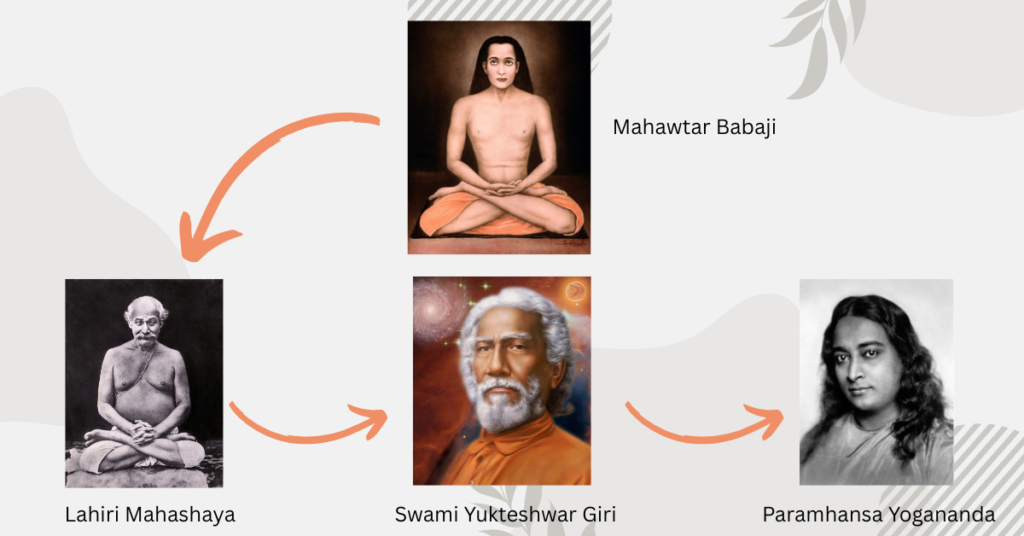
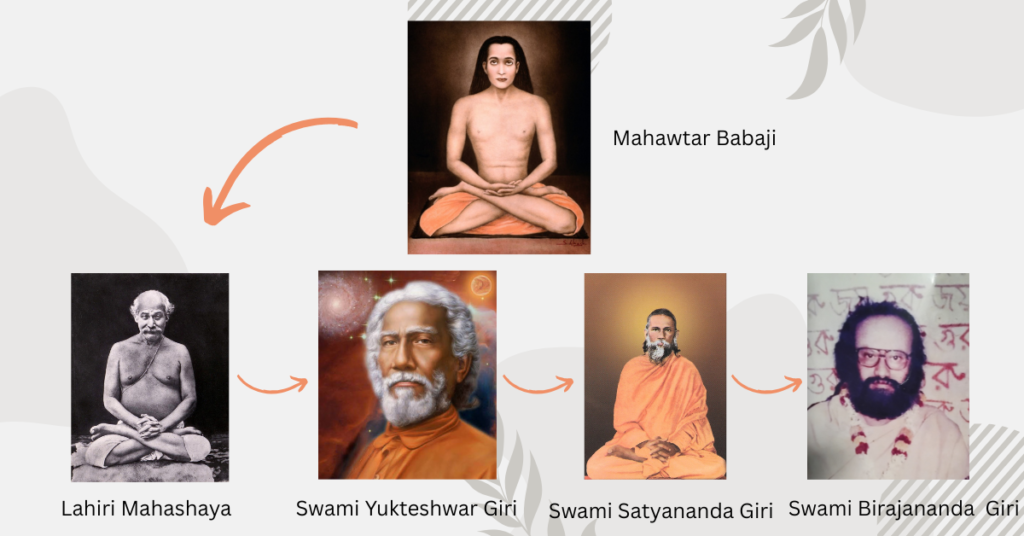
The lineage is not simply a historical succession of teachers. In the traditional understanding of Kriya Yoga, the relationship between teacher and disciple is an important part of the spiritual path. The teachings are transmitted through personal guidance, practice, and the gradual development of the disciple’s sadhana.
For this reason, the practice is traditionally approached differently from a general wellness practice that can be learned entirely from a book or online tutorial.
Sri Yukteswar Giri: Kriya Within the Broader Science of Yoga
Swami Sri Yukteswar Giri was one of the central teachers in the lineage and the guru of Paramahansa Yogananda.
His teachings are especially relevant when understanding Kriya within the broader framework of Yoga.
Kriya is not traditionally viewed in isolation from the relationship between prana, mind, concentration and meditation. Practices involving prana are understood within a larger process of refining attention and turning awareness inward.
This gives Kriya a place within a broader spiritual discipline.
Rather than asking only what a particular Kriya practice does to the breath, it is more useful to consider how disciplined work with prana and attention fits into the practitioner’s movement towards meditation and Self-realization.
Sri Yukteswar’s teachings and his interpretation of yogic and scriptural principles therefore help place Kriya within a broader spiritual path rather than presenting it as an isolated exercise.
Paramahansa Yogananda and the Wider Recognition of Kriya Yoga
Paramahansa Yogananda played a major role in introducing Kriya Yoga to a much wider audience.
Through his teachings, lectures and Autobiography of a Yogi, he brought the lives and teachings of Lahiri Mahasaya and Sri Yukteswar to readers far beyond India. His presentation placed the practice within his broader teaching of meditation and spiritual development.
Yogananda described Kriya in relation to prana, meditation and the inward development of consciousness. His writings helped establish the modern public understanding of the tradition, while the detailed practices themselves remained associated with initiation and personal instruction within the tradition.
His accounts also include the traditional history of the lineage, including the story of Mahavatar Babaji. These accounts are significant for understanding how the lineage understands its own history, while historical scholarship may approach such claims differently.
Keeping these perspectives distinct allows the spiritual tradition to be presented respectfully without treating every traditional account as though it were independently established historical evidence.
Swami Satyananda Giri and the Preservation of the Tradition
Swami Satyananda Giri was a disciple of Sri Yukteswar and a close associate of Paramahansa Yogananda. His writings provide an important perspective from within the lineage.
His biographical works concerning Lahiri Mahasaya, Sri Yukteswar and Yogananda, together with his writings on the tradition, help preserve the teachings and the lived character of the tradition.
Satyananda’s perspective is particularly valuable in understanding Kriya as sadhana and inner development rather than reducing it to a collection of breathing exercises.
His writings also help illustrate why regularity, sincerity, guidance and gradual development are important themes in traditional Kriya teaching.
For the modern practitioner, this offers an important distinction: learning about Kriya Yoga and receiving and practicing it within its traditional setting are not the same thing.
What Is the Purpose of Kriya Yoga?
The traditional purpose of Kriya Yoga is spiritual.
The practice is directed towards turning awareness inward, refining attention and deepening meditation. Breath and prana are important within this process, but they are not the final purpose of the practice.
The deeper goal is Self-realization and realization of God.
For this reason, Kriya Yoga should not be understood primarily as a method for relaxation, better sleep, physical wellbeing or stress management. A practitioner may experience calmness or greater mental steadiness, but such experiences are not the ultimate aim traditionally associated with the practice.
This spiritual purpose is what gives the practice its distinctive character within the yogic path.
Kriya Yoga and Pranayama
Kriya and pranayama are closely related, but they are not interchangeable terms.
Pranayama is one of the classical limbs of Yoga and concerns the regulation and refinement of prana through practices involving the breath.
The practice includes practices connected with prana and breath, but within the Lahiri Mahasaya tradition these practices form part of a wider spiritual discipline involving meditation and inward awareness.
Therefore, describing Kriya simply as “advanced pranayama” gives an incomplete picture. A more useful way to understand the relationship is:
Pranayama is an important part of the classical yogic approach to prana, while the practice places its traditional practices within a broader path of meditation and spiritual realization.
The exact methods and progressive stages of Kriya are traditionally learned through appropriate instruction. A general article can explain the principles and purpose without attempting to replace that instruction.
How Is Kriya Yoga Traditionally Practised?
The practice is traditionally practised as part of regular sadhana, or spiritual discipline.
The details vary according to the stage of practice and the instruction received, but the broader discipline involves qualities common to serious yogic practice:
- regularity and sincerity
- an attentive and steady mind
- awareness of breath and prana
- progressive development of concentration
- meditation and inward observation
- patience and discipline
- respect for the teacher and the tradition
The exact Kriya practices are traditionally taught progressively. For this reason, a responsible introduction should not present a simplified online version as though it were the complete traditional practice.
A person can nevertheless prepare for deeper yogic practice by cultivating regular meditation, learning appropriate foundational pranayama, developing concentration and studying the principles of Yoga under suitable guidance.
Why Is Kriya Yoga Traditionally Learned Through a Teacher?
The teacher-disciple relationship has an important place in the Kriya Yoga tradition.
Traditional lineage sources describe Kriya as being transmitted from teacher to disciple rather than reconstructed from written descriptions. This approach reflects the progressive nature of the practice and the importance traditionally placed on personal guidance.
A teacher can help a practitioner understand the practice according to their stage of development, correct misunderstandings and place individual practices within the larger spiritual path.
This is different from learning a general breathing exercise from a book or online video.
A person can certainly study the tradition through books and articles. Such study can provide valuable understanding of its history, philosophy and purpose. But intellectual knowledge should not be confused with initiation or direct instruction in traditional Kriya practice.
Kriya Yoga, Pratyahara, Dharana, Dhyana and Samadhi
The practice can also be understood in relation to the inward movement described in classical Yoga.
As attention becomes less scattered, the practitioner becomes increasingly capable of turning inward. This connects with several important yogic concepts.
Pratyahara refers to the withdrawal of the senses away from their habitual outward movement.
Dharana refers to bringing the mind back to one point and maintaining awareness there with steadiness.
Dhyana is sustained meditation, in which awareness becomes increasingly continuous and less interrupted.
Samadhi refers to a deeper state of meditative absorption. The practice should not be presented as though performing a particular practice automatically produces these states. Rather, within the traditional understanding, disciplined practice supports the gradual refinement of attention and the deepening of meditation.
This is another reason Kriya is better understood as a path of practice and realization rather than as a single exercise.
Kriya Yoga as a Spiritual Path
A spiritual path involves more than learning techniques.
Within the tradition, regularity, self-discipline, sincerity, humility and sustained attention form part of the practitioner’s approach to spiritual practice.
The wider yogic tradition also emphasizes that spiritual development is not entirely separate from the way one lives. Meditation is practised formally, but the qualities cultivated through practice can gradually influence one’s relationship with thoughts, emotions, actions and others.
The deeper aspiration is Self-realization and realization of God.
Kriya Yoga and the Bhagavad Gita
The Bhagavad Gita is an important scriptural source within the wider yogic tradition and has a significant place in the lineage associated with Sri Yukteswar.
The Gita presents Yoga through several interconnected approaches, including disciplined action, meditation, devotion and knowledge.
This broader framework is useful when considering Kriya Yoga.
Kriya is not traditionally understood in isolation from principles such as disciplined living, self-knowledge, meditation and surrender that occur throughout the Gita and other yogic teachings.
The relationship between the Gita’s teachings and the Kriya Yoga tradition is best understood in the context of the interpretations preserved within the lineage rather than reduced to a single modern explanation.
Kriya Yoga and Scientific Research
The practice is traditionally understood as a spiritual path directed towards Self-realization and realization of God. Its practice concerns not only the body or breath, but also meditation, inward
awareness and spiritual development. Its ultimate purpose therefore belongs to the deeper dimension of Yoga.
Scientific research can offer another perspective by examining aspects of yogic practice that can be observed and measured. Studies may investigate breathing patterns, physiological responses, attention, stress, sleep and other measurable dimensions associated with particular practices.
Such research can help illuminate some observable aspects of practice without defining its spiritual purpose.
It is also important to recognize that the name Kriya Yoga is used in more than one context. For example, Sudarshan Kriya Yoga has been studied in scientific research, but findings from those studies should not automatically be presented as research on the Kriya Yoga tradition associated with Lahiri Mahasaya, Sri Yukteswar and their lineage. Different practices should be considered according to their own teachings and methods.
Research on breathing, meditation and related yogic practices may therefore provide insight into certain physiological and psychological dimensions of practice. These findings should be understood within their proper scope rather than extended automatically to the entire Kriya Yoga tradition.
Scientific inquiry and the traditional teachings of the practice can be approached from their respective perspectives. Scientific research can examine observable dimensions of practice, while the traditional teachings explain its spiritual purpose and place within the path of realization.
Physiological and psychological measurements address measurable dimensions of experience; they do not provide a measure of the direct experience of Self-realization or realization of God.
Kriya Yoga therefore remains, in its traditional understanding, a path of Self-realization, spiritual awakening and realization of God. Scientific research may help illuminate certain dimensions associated with practice, but it does not define or exhaust the deeper purpose of the practice.
Can Beginners Practise Kriya Yoga?
A beginner can certainly learn about the tradition and begin preparing for a serious yogic practice.
Traditional Kriya practices, however, are generally approached through appropriate instruction rather than reconstructed from online descriptions.
A beginner can begin by developing foundational qualities such as regular meditation, awareness of natural breathing, concentration and disciplined practice under suitable guidance.
The purpose of such preparation is not to imitate advanced Kriya techniques, but to cultivate steadiness, awareness and sincerity.
Does Kriya Yoga Have Health Benefits?
The practice is traditionally a spiritual discipline, so health benefits should not be presented as its primary purpose.
Practices involving breath, attention and meditation may be associated with experiences such as calmness or mental steadiness. Research into breathing and meditation also provides findings concerning possible physiological and psychological effects.
However, findings from one breathing or meditation practice should not automatically be attributed to the entire tradition.
The practice should therefore not be presented as a treatment for a medical condition or as a substitute for appropriate healthcare.
Can Kriya Yoga Be Learned Online?
Online resources can be useful for learning about the history, philosophy and spiritual purpose of the tradition.
They can help a person understand the lives and teachings of Lahiri Mahasaya, Sri Yukteswar, Paramahansa Yogananda and Swami Satyananda Giri, as well as the broader yogic framework in which Kriya is presented.
Reading about Kriya, however, is different from receiving traditional instruction in Kriya practice.
Where a practice is traditionally transmitted through a teacher, online instructions should not be assumed to provide the same guidance, context or progressive instruction.
How Often Should Kriya Yoga Be Practised?
Traditional spiritual practice places importance on regularity.
The appropriate duration and frequency, however, depend on the particular practice, the practitioner’s experience and the guidance received.
Rather than trying to imitate the schedule of an experienced practitioner, a beginner should develop a sustainable discipline and progress gradually.
For spiritual practice, sincere and regular engagement is generally more meaningful than occasional periods of excessive effort.
What Should a Beginner Understand Before Starting Kriya Yoga?
Before approaching the tradition, it is useful to keep a few principles in mind:
- Kriya is a spiritual discipline, not merely a breathing exercise.
- The term Kriyā Yoga also appears in Patanjali’s Yoga Sutras and should be understood in its classical context.
- The Kriya Yoga tradition associated with Lahiri Mahasaya has its own lineage and traditional method of transmission.
- Traditional Kriya practice is taught progressively.
- Breath and prana have an important place, but they belong to a wider path of meditation and inward development.
- Traditional spiritual accounts and independently documented history are not always the same kind of evidence.
- Scientific research can illuminate observable aspects of practice but does not define the spiritual purpose of the practice.
Approaching Kriya with patience, sincerity and respect for its traditional purpose allows its teachings to be understood more deeply.
Final Thoughts
The tradition has an important place in the modern history of Yoga. Through Lahiri Mahasaya, Sri Yukteswar, Paramahansa Yogananda, Swami Satyananda Giri and the wider lineage, its teachings have continued to reach practitioners across generations.
Yet the tradition is best understood not simply as a technique, but as a path of disciplined inner practice and spiritual realization.
Its traditional emphasis on prana, meditation, concentration and inward awareness points towards a deeper purpose: the refinement of consciousness and the realization of the Self.
For a sincere practitioner, the path is not about collecting techniques or seeking immediate results. It calls for regular practice, appropriate guidance, self-discipline and a genuine aspiration for spiritual realization.
A Note on Tradition and Sources
This article presents the tradition primarily through the traditional understanding associated with the lineage of Lahiri Mahasaya and Sri Yukteswar Giri, drawing on the teachings and writings of Paramahansa Yogananda, Swami Satyananda Giri and other lineage sources.
The tradition is also discussed in the context of the classical Yoga tradition, including references to Kriyā Yoga in Patanjali’s Yoga Sutras and related teachings in the Bhagavad Gita. The
relationship between these classical references and the tradition transmitted through the lineage can be understood in the light of the teachings of the lineage itself. This article therefore does not attempt to establish a definitive separation or equivalence between them, but presents both within the broader yogic understanding of spiritual practice and realization.
Where traditional accounts involve matters that cannot be independently established through historical sources, they are presented in their traditional context.
Detailed Kriya practices, particularly those traditionally taught through initiation and personal guidance, are not reproduced here. This article focuses instead on the meaning, history, lineage,
philosophy and spiritual purpose of the tradition.
About the Author
Yogacharya Dhruv Ji is a Yoga teacher and practitioner committed to preserving and sharing the traditional teachings of Yoga and Kriya Yoga. Dhruv Ji received his training in Yoga and Kriya Yoga under the guidance of Swami Birajananda Giri Maharaj, with an emphasis on yogic philosophy, meditation, and traditional spiritual practices.
Disclaimer
This article is intended for educational and general wellness information. It is not a substitute for instruction from a qualified Yoga teacher or for professional medical advice, diagnosis or treatment. Anyone with a health condition, who is pregnant, recovering from illness or injury, or uncertain about a particular practice should seek appropriate professional guidance before beginning or modifying a Yoga practice.