
Sri Yukteswar Giri: Life, Teachings, Kriya Yoga and The Holy Science
Sri Yukteswar Giri was a Kriya Yoga teacher and the spiritual guru of Paramahansa Yogananda.
He presented his philosophical ideas in a book titled The Holy Science.
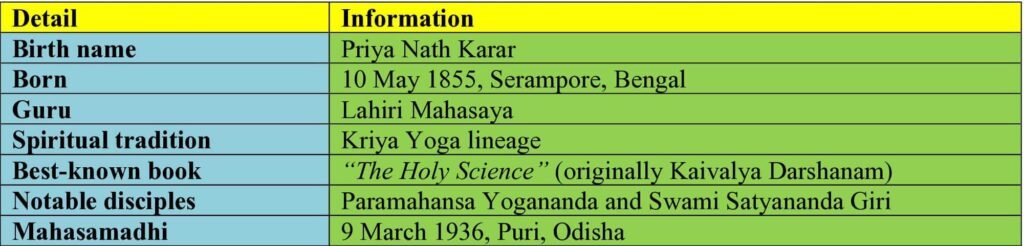
Born Priya Nath Karar in Serampore, Bengal, on 10 May 1855, he later became a monk in the Giri branch of the Swami order. He attained Mahasamadhi in Puri, Odisha, on 9 March 1936.
Originally titled Kaivalya Darshanam, The Holy Science examines parallels between Hindu scriptures and the Christian Bible. Another subject explored in the text is Sri Yukteswar’s account of the four yugas and the changes in human consciousness that he associated with them.
Sri Yukteswar Giri at a Glance
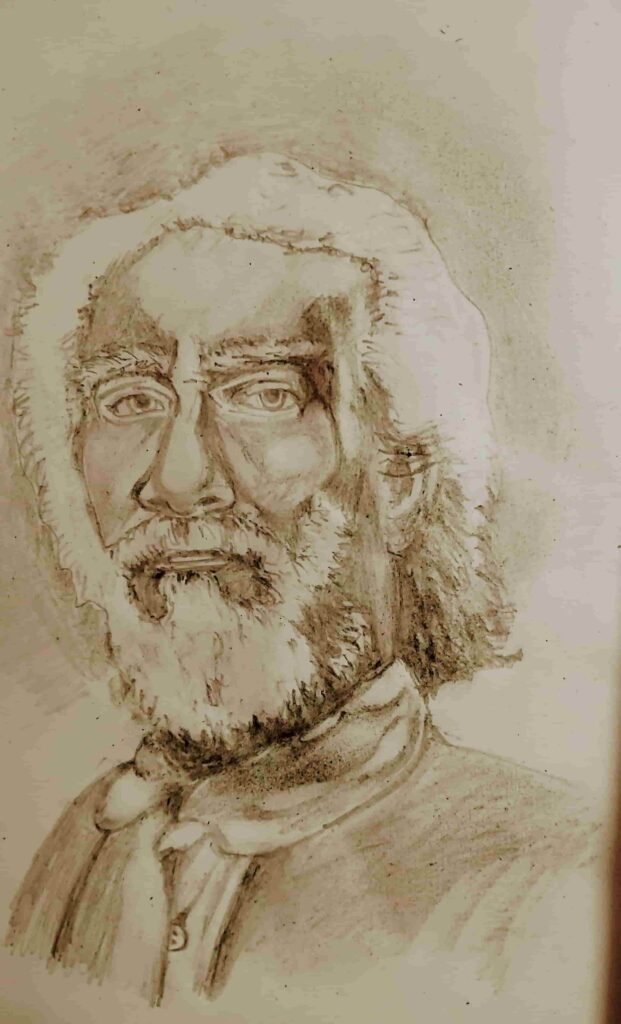
Who Was Sri Yukteswar Giri?
Sri Yukteswar Giri was the monastic name of Priya Nath Karar. He belonged to the Giri branch of the Swami order and taught students at spiritual centres in Serampore and Puri.
Accounts of Sri Yukteswar’s life appear in Paramahansa Yogananda’s Autobiography of a Yogi and in biographical works by other disciples. These sources offer personal perspectives on his character, teaching methods and spiritual life.
Early Life of Priya Nath Karar
Priya Nath Karar was born in Serampore, Bengal, on 10 May 1855. Before entering monastic life, he married and lived as a householder.
In Autobiography of a Yogi, Paramahansa Yogananda shares details that Sri Yukteswar told him about his early life, including his family home and daughter. According to Yogananda’s account, Sri Yukteswar entered the Swami order after his wife’s death and became known as Sri Yukteswar Giri.
Sri Yukteswar and Lahiri Mahasaya
Lahiri Mahasaya was Sri Yukteswar’s guru. Sri Yukteswar received Kriya Yoga initiation from him. Accounts from the Kriya Yoga tradition say they met in 1884. The traditional Kriya Yoga lineage is traced through the following teachers:
Mahavatar Babaji → Lahiri Mahasaya → Sri Yukteswar Giri
Sri Yukteswar’s notable disciples included:
- Paramahansa Yogananda
- Swami Satyananda Giri
Sri Yukteswar and Mahavatar Babaji
According to the account shared in Paramahansa Yogananda’s Autobiography of a Yogi, Sri Yukteswar met Mahavatar Babaji at the Kumbha Mela in Allahabad, now called Prayagraj, in 1894.
According to Yogananda’s account, Babaji encouraged Sri Yukteswar to write a work exploring connections between Hindu and Christian scriptures. Sri Yukteswar produced The Holy Science, originally titled Kaivalya Darshanam. The same account relates that Babaji foresaw Sri Yukteswar training a disciple who would carry Indian spiritual teachings to Western audiences.
These events are important in the Kriya Yoga tradition. They should be understood as spiritual accounts passed down through the lineage, rather than as events independently confirmed by historical records.
Sri Yukteswar and Paramahansa Yogananda
In 1910, Mukunda Lal Ghosh, later known as Paramahansa Yogananda, met Sri Yukteswar in Benares (present-day Varanasi) and entered a guru–disciple relationship with him.
For readers seeking Yogananda’s own account of his guru, Autobiography of a Yogi provides a personal perspective on Sri Yukteswar’s character and instruction. Through his account, Yogananda also describes the importance of self-control, disciplined conduct and self-examination in his guru’s approach to spiritual training.
Yogananda travelled to the United States in 1920 to teach yoga and spiritual philosophy. Sri Yukteswar remained in India, where he continued guiding his students. Published in 1946, Autobiography of a Yogi brought Yogananda’s account of his guru to a much wider readership.
Sri Yukteswar and Swami Satyananda Giri
Swami Satyananda Giri, whose birth name was Manamohan Mazumder, was a disciple of Sri Yukteswar and a childhood friend of Paramahansa Yogananda. His association with Karar Ashram in Puri and his biographical writing made him a source of accounts about Sri Yukteswar’s life and teachings.
Satyananda wrote about his guru’s life in Bengali. The English-language collection A Collection of Biographies of 4 Kriya Yoga Gurus includes a translated biography listed under the title Swami Sriyukteshvar Giri Maharaj: A Biography.
Like other accounts written by disciples, these works reflect the writers’ own experiences and relationship with their guru. Reading more than one account can give a fuller picture, while remembering that personal memories and independently documented facts are not the same.
Sri Yukteswar’s Ashrams and Teaching Life
Sri Yukteswar maintained spiritual centres in Serampore, Bengal, and Puri, Odisha, with Karar Ashram serving as his centre in Puri.
Sri Yukteswar Giri’s Main Teachings
Self-Realization and Discipline
For Sri Yukteswar, a person’s conduct was an important part of spiritual development. He emphasised self-control, consistent practice and the willingness to examine one’s own actions.
The Guru–Disciple Relationship
For Sri Yukteswar, the guru–disciple relationship involved more than receiving spiritual instruction. His approach, as described in Paramahansa Yogananda’s account, emphasised personal guidance, self-examination, and disciplined effort on the path to spiritual understanding.
Links Between Hindu and Christian Teachings
In The Holy Science, Sri Yukteswar examined passages from Hindu sacred texts alongside teachings from the Christian Bible. His purpose was to explain the spiritual principles he believed could be understood through both traditions.
His comparison reflects his own reading of these scriptures. It should not be taken to mean that Hinduism and Christianity are identical in their beliefs, practices or theology.
Spiritual Growth and Discrimination
Sri Yukteswar’s philosophy linked a person’s spiritual development with the ability to distinguish sound understanding from mistaken judgement. In this context, discrimination means examining ideas carefully instead of accepting them without reflection.
In Sri Yukteswar’s account of the four yugas, each age represents a different stage in humanity’s understanding of the world and spiritual life. Together, these ideas show how he approached spiritual development through both personal discernment and his broader understanding of cosmic time.
Sri Yukteswar’s Place in Kriya Yoga
Sri Yukteswar’s role in the Kriya Yoga tradition included training Paramahansa Yogananda, who later carried these teachings to audiences beyond India.
For a broader introduction to the practice and its spiritual purpose, read our guide to Kriya Yoga.
The Holy Science: Sri Yukteswar’s Best-Known Book
The Holy Science is Sri Yukteswar’s main written work. It was first titled Kaivalya Darshanam, and its introduction is dated 1894. In the book, Sri Yukteswar sets out his interpretation of spiritual principles through a comparison of Hindu and Christian religious texts.
The book has four parts:
The Gospel
Here, Sri Yukteswar offers his reading of selected Hindu and Christian scriptural passages.
The Goal
Sri Yukteswar turns to the end that spiritual seeking is meant to serve.
The Procedure
The focus shifts to the work involved in spiritual practice and inner development.
The Revelation
In the closing part, Sri Yukteswar explores spiritual knowledge in relation to his understanding of the universe and humanity.
What Makes The Holy Science Important?
The significance of The Holy Science lies in Sri Yukteswar’s attempt to interpret Hindu and Christian scriptures through a shared spiritual framework. His conclusions reflect his own philosophical interpretation and should be distinguished from universally accepted religious doctrine or scientifically established explanations of cosmic cycles.
Sri Yukteswar’s Yuga Theory
Hindu traditions describe four yugas: Satya, Treta, Dvapara and Kali. Sri Yukteswar offered his own way of calculating these ages, which differs from the much longer periods found in many Puranic accounts.
In his model, one full cycle lasts 24,000 years. It has an ascending phase of 12,000 years and a descending phase of 12,000 years. He used this cycle to explain his understanding of how human consciousness changes over time.
Unlike a model of time that moves in only one direction, Sri Yukteswar’s interpretation allows for both ascending and descending phases. This differs from accounts that describe the ages mainly as a gradual decline.
The 24,000-year cycle is Sri Yukteswar’s particular interpretation. It is not the only calculation found in Hindu traditions, and it is not an established scientific account of human history.
Sri Yukteswar as a Scholar and Teacher
Sri Yukteswar’s scholarship brought together the study of religious texts and his interest in Jyotisha, or traditional Indian astrology.
Final Years and Spiritual Legacy
Sri Yukteswar Giri continued guiding his students until his death. He attained Mahasamadhi in Puri, Odisha, on 9 March 1936.
His legacy is preserved through The Holy Science and the accounts and teachings passed down by disciples such as Paramahansa Yogananda and Swami Satyananda Giri.
Frequently Asked Questions
Who was Sri Yukteswar Giri?
Sri Yukteswar Giri (1855–1936) was an Indian spiritual guru in the Kriya Yoga tradition. He received initiation into Kriya Yoga from Lahiri Mahasaya, provided guidance to Paramahansa Yogananda and Swami Satyananda Giri, and authored the book The Holy Science.
Who was Sri Yukteswar’s guru?
His guru was Lahiri Mahasaya, from whom he received Kriya Yoga initiation. Accounts from their spiritual lineage place their meeting in 1884.
Was Sri Yukteswar the guru of Paramahansa Yogananda?
Yes. Yogananda became his disciple in 1910 and later wrote about their relationship in Autobiography of a Yogi.
What is The Holy Science about?
Originally titled Kaivalya Darshanam, The Holy Science presents Sri Yukteswar’s interpretation of Hindu and Christian scriptures and his theory of the yuga cycles.
Did Swami Satyananda Giri write about Sri Yukteswar?
Yes. Swami Satyananda Giri wrote a Bengali account of Sri Yukteswar’s life. An English-language collection titled A Collection of Biographies of 4 Kriya Yoga Gurus includes a translated biography of Sri Yukteswar.
Sources and Further Reading
Explore these sources to learn more about Sri Yukteswar Giri and his teachings:
Sri Yukteswar Giri: Key Dates
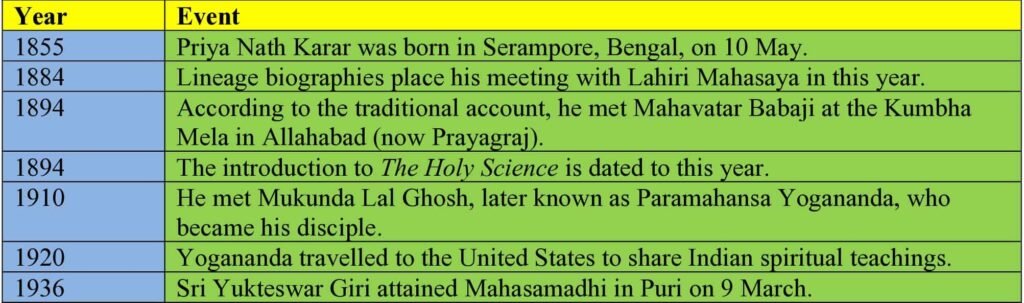
Note: The meeting with Mahavatar Babaji and Babaji’s request to write The Holy Science come from the Kriya Yoga lineage tradition. The date of the book’s introduction is not the same as its first publication date.
- Yukteswar Giri, Sri. The Holy Science. A work on Hindu and Christian scriptures and Sri Yukteswar’s interpretation of the yuga cycles. Check the edition and publisher details through Yogoda Satsanga Society of India.
- Yogananda, Paramahansa. Autobiography of a Yogi. Yogananda’s account of his spiritual journey, his guru Swami Sri yukteswar Giri and the Kriya Yoga lineage.
- Swami Sri Satyananda Giri. A Collection of Biographies of 4 Kriya Yoga Gurus. This collection includes English translations of biographical works first written in Bengali.
Final Thoughts
Sri Yukteswar Giri’s legacy brings together Kriya Yoga, disciplined spiritual practice, scriptural interpretation, and a distinctive understanding of the yuga cycles. Through *The Holy Science* and the accounts of his disciples, his ideas continue to interest readers exploring the relationship between Indian spiritual traditions and wider philosophical questions.
Studying his life offers an opportunity to understand not only his teachings but also the lineage through which they were shared. Reading his work alongside biographical accounts can help readers form a more complete understanding of his contribution to modern spiritual thought.
Disclaimer
This article is intended for educational and informational purposes. It discusses Sri Yukteswar Giri’s life and teachings using biographical accounts and the traditions associated with Kriya Yoga. Spiritual experiences, lineage traditions, and interpretations of the yuga cycles are presented as such and should not be understood as independently verified historical or scientific conclusions. Readers interested in his teachings are encouraged to consult the original texts and relevant biographical sources.
About the AuthorYogacharya Dhruv Ji is a Yoga Teacher and practitioner committed to preserving and sharing the authentic wisdom of traditional Yoga and Kriya Yoga. Dhruv Ji received his training in Yoga and Kriya Yoga under the esteemed guidance of Swami Birajananda Giri Maharaj, a revered spiritual teacher known for his deep understanding of yogic philosophy, meditation, and the ancient practices of self-realization. |