
5 Benefits of Tadasana (Mountain Pose) and How to Practise It
Tadasana, commonly known as Mountain Pose, is a standing yoga posture associated with steadiness, balance, and mindful awareness. Just as a mountain stands tall, stable, and calm, Tadasana encourages steadiness, balance, and awareness.
Tadasana or Mountain Pose looks simple, but it is an important standing posture in yoga. It teaches us to become aware of how we stand, breathe, and maintain balance. Many standing yoga sequences use Mountain Pose as a starting or transitional position.
In this article, we will learn how to do Mountain Pose, its variations, beginner tips, common mistakes, anatomy, counter poses, and why teachers and practitioners value it.
Mountain Pose History
Tadasana belongs to the development of modern postural yoga. While yoga has ancient roots and a long history of physical and contemplative practices, the standing form of Mountain Pose commonly practised today developed within modern yoga traditions. Scholars note that many familiar modern yoga postures and sequences took shape as yoga evolved during the 19th and 20th centuries.
Today, Tadasana is widely used as a reference point for standing alignment, balance, and body awareness. Different yoga traditions may teach the posture with variations in alignment and emphasis, so the way Mountain Pose is practised can differ between teachers and lineages.
What Is Tadasana in Yoga?
Mountain Pose is a standing posture where the body is upright, aligned, and still. It is often used:
- At the beginning of a yoga session
- Between standing poses
- As a posture of awareness and grounding
Although it looks like “just standing,”
Mountain Pose is an active pose that engages the entire body.
How to Do Mountain Pose
Stand upright on your yoga mat with your feet comfortably positioned.
Place your feet together or slightly apart, with your toes pointing generally forward.
Spread your toes and press the four corners of each foot evenly into the mat.
Engage your legs gently without locking your knees.
Let your pelvis settle naturally, without forcing it forward or backward.
Lengthen your spine and imagine the crown of your head reaching upward.
Relax your shoulders and let them move naturally down and away from your ears.
Rest your arms by your sides, with your palms facing forward or toward your thighs, depending on what feels natural.
Keep your chin level and relax your facial muscles.
Breathe slowly and comfortably, preferably through the nose if that feels natural.
Hold Tadasana for 30 seconds to 1 minute, or for as long as you can maintain comfortable, steady breathing and good alignment. Repeat the pose a few times if it feels comfortable and you can maintain steady breathing and relaxed alignment.
Tadasana Alignment: 5 Key Points to Remember
Ground the feet evenly through all four corners of the feet.
Engage the legs gently without locking the knees.
Lengthen the spine while keeping the pelvis neutral and comfortable.
Relax the shoulders and arms without forcing them into position.
Maintain steady breathing and awareness throughout the pose.
What Are the Benefits of Tadasana?
Mountain Pose offers many physical, mental, and emotional benefits.
1. Improves Posture and Body Alignment
Regular Tadasana practice helps you notice the position of your spine and the way you hold yourself while standing. This awareness can carry over into everyday movements such as walking and working.
2. Supports Balance and Stability
By standing with an even distribution of weight and maintaining a stable base, Tadasana gives you an opportunity to practise controlled balance. This can be especially useful when learning other standing yoga postures.
3. Builds Body Awareness and Concentration
Remaining still in Tadasana gives you time to notice your breath, posture, and the sensations in your body. Keeping your attention on these details can make the practice more mindful and focused.
4. Encourages Steady, Comfortable Breathing
Tadasana encourages an upright posture that can make it easier to notice and maintain a steady breathing pattern. As you stand with the spine lengthened and the shoulders relaxed, you can practise slow, comfortable breaths without forcing the breath.
5. Gently Engages the Legs and Core
Holding Tadasana with good alignment involves subtle muscular effort. The lower body provides support from the feet upward, while the abdominal and back muscles help you maintain a tall, balanced stance.
Beginner Tips for Mountain Pose
- Use a mirror when helpful: Glancing at your reflection can give you a better idea of how your body is positioned.
- If you feel unsteady, try a wider stance: Place your feet slightly apart to create a more comfortable base.
- Don’t force the knees straight: Keep a small amount of softness in the knees rather than pressing them backward.
- Soften the face and shoulders: Let the jaw, eyes, and shoulders remain relaxed while you stand.
- Breathe steadily: Keep your breathing slow and comfortable without forcing deeper breaths.
Mountain Pose may seem simple at first, but paying attention to alignment and breathing can make it a more mindful practice.
Common Misalignments in Mountain Pose
Even though Tadasana looks simple, small alignment errors can affect how comfortable and stable the pose feels.
Common mistakes to watch for:
- Locking the knees
- Shifting the body too far forward or backward
- Raising the shoulders toward the ears
- Letting the inner edges of the feet roll downward
- Pushing the head forward instead of keeping it comfortably aligned
These simple checks can make the posture feel more natural and help you stay aware of your alignment while practising Tadasana.
Mountain Pose Variations
Tadasana can be adapted in several simple ways to make the practice more comfortable and accessible for different needs and experience levels.
Mountain Pose With Feet Apart
For this variation, keep your feet about hip-width apart.
Benefits:
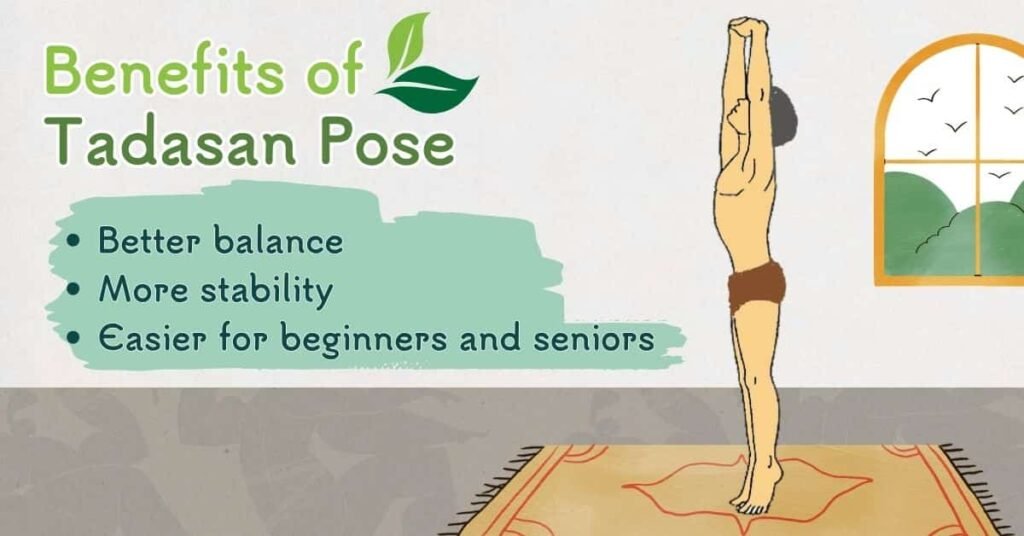
- Better balance
- More stability
- Easier for beginners and seniors
This variation may feel more stable and comfortable for beginners who find balancing difficult.
Mountain Pose Against a Wall
Stand with your back to a wall, keeping your hips, shoulders, and head gently aligned with it. Keep your feet hip-width apart and a few inches away from the wall while practising Tadasana.
Why this helps:
- Improves posture awareness
- Teaches spinal alignment
- Great for beginners
This variation helps you become more aware of the alignment used in Tadasana.
Mountain Pose in a Chair
Sit comfortably in the chair, keeping both feet grounded and your upper body naturally upright.
How to do it:
- Sit tall without leaning back
- Place hands on thighs
- Lengthen your spine
- Relax shoulders and face
Practising Tadasana from a chair can be a convenient option when standing for the pose is not comfortable or practical.
Why We Love Mountain Pose
Mountain Pose may look small, but its benefits are big.
We love it because it:
- Improves posture
- Builds confidence and stability
- May promote a calmer state
- Increases body awareness
- Teaches mindfulness
Spiritually, Tadasana reminds us to stand strong, steady, and rooted, just like a mountain—calm in all situations.
Anatomy of Mountain Pose
Mountain Pose engages the whole body.
Key muscles involved:
- Quadriceps and hamstrings (legs)
- Gluteal muscles (hips)
- Core muscles (abdomen and trunk)
- Spinal extensors (spine support)
- Muscles of the feet and ankles
Joints used:
- Ankles
- Knees
- Hips
- Spine
- Shoulders
Proper alignment ensures even weight distribution and healthy posture.
Common Mistakes to Avoid in
Mountain Pose
- Locking the knees
- Leaning forward or backward
- Lifting shoulders toward the ears
- Collapsing the chest
- Holding the breath
Correcting these common mistakes can make Tadasana more comfortable and help you practise with greater awareness.
Mountain Pose and Alignment
Proper alignment in Tadasana includes:
- Ears over shoulders
- Shoulders over hips
- Hips over ankles
This alignment can support more balanced posture and body awareness.
Tadasana and Posture
Tadasana retrains the body to stand correctly. Over time, this posture awareness carries into daily activities like walking, sitting, and working.
Tadasana and Body Awareness
By standing still and observing sensations, Tadasana develops a strong mind–body connection, This practice encourages you to pay closer attention to your breathing, posture, and the sensations in your body.
Tadasana and Breathing
Breathing in Tadasana should be:
- Slow
- Deep
- Through the nose
Slow, comfortable breathing can help you remain relaxed and attentive while holding Tadasana.
Tadasana and Meditation
Tadasana can also be practised as a form of standing meditation. Focusing on the breath and posture while standing can encourage greater awareness and a sense of steadiness.
Tadasana and Chakras
In traditional yoga frameworks, Tadasana is sometimes associated with:
- Muladhara (Root Chakra) – grounding and stability
- Anahata (Heart Chakra) – openness and balance
This creates both physical and energetic alignment.
Tadasana vs. Samasthiti: What’s the Difference?
- Tadasana focuses on stretching, alignment, and awareness.
- Samasthiti is a neutral standing posture used mainly in Ashtanga Yoga.
Both are standing postures associated with balance and awareness, although their use and emphasis can differ across yoga traditions and schools.
How to Incorporate Tadasana Into Your Yoga Practice
- To ground yourself, begin your Yoga practice with Tadasana (Mountain Pose).
- Use it between standing poses
- Practise it regularly to develop greater awareness of standing posture.
- Combine it with pranayama or meditation
Counter Poses for Mountain Pose
After holding Mountain Pose for some time, gentle counter poses help relax the body.
Uttanasana (Standing Forward Bend)
From Mountain Pose, fold forward from the hips.
Benefits:
- Releases spine and hamstrings
- Calms the mind
- Relieves tension
This pose provides a contrasting movement to the upright position of Tadasana.
Utkatasana (Chair Pose)
A strong, active pose that builds heat.
Benefits:
- Strengthens legs and core
- Improves stamina
- Builds focus
It complements Mountain Pose by adding movement and effort.
Savasana (Corpse Pose)
The ultimate resting pose.
Benefits:
- Deep relaxation
- Nervous system recovery
- Mental calmness
Ending the practice with Savasana provides an opportunity to rest and transition out of the standing sequence.
Concluding Thoughts
Mountain Pose may appear simple, but it offers a valuable foundation for developing better awareness of posture, breathing, and stillness. Whether you are new to yoga or have been practising for years, returning to Tadasana can help you reconnect with your body and observe how you stand, breathe, and move.
Regular practice may support better posture, balance, and body awareness, while its quiet and steady nature can make it a useful addition to yoga, breathing exercises, or meditation.
Practice Tadasana with patience and attention. Like a mountain, let your body remain steady while your awareness stays present.
About the AuthorYogacharya Dhruv Ji is a Yoga Teacher and practitioner committed to preserving and sharing the authentic wisdom of traditional Yoga and Kriya Yoga. Dhruv Ji received his training in Yoga and Kriya Yoga under the esteemed guidance of Swami Birajananda Giri Maharaj, a revered spiritual teacher known for his deep understanding of yogic philosophy, meditation, and the ancient practices of self-realization. |
Disclaimer
This article is intended for general informational and educational purposes only. It is not intended to prescribe or recommend a specific method of yoga practice or to replace professional medical advice.
Before beginning yoga asana practice, consider your individual health, physical condition, and any existing medical concerns. If you have a medical condition, injury, or other health-related concern, consult a qualified healthcare professional and, where appropriate, an experienced yoga teacher before practising.
Practise within your own comfortable limits and stop if you experience pain, dizziness, or discomfort. Yoga practices may not be suitable for everyone, and individual results can vary.
Yoga Vasundhara does not accept responsibility for any injury, loss, or adverse outcome resulting from the use or practice of information provided in this article.
For additional information about yoga practice and safety, see the National Center for Complementary and Integrative Health (NCCIH).