
Udgith Pranayama: Its meaning, Benefits, Steps, Precautions and Om Chanting
Udgith pranayama, commonly known as Om chanting pranayama, is a traditional breathing technique in which the sacred syllable Om is chanted rhythmically during exhalation. It is practiced to encourage relaxation, improve breath awareness, and support meditation.
In this article, you will learn how to practice Udgith Pranayama, its potential benefits, precautions, and how it is different from Pranava Pranayama. Along with this, we will learn about its traditional importance and answers to common questions about Om chanting and pranayama.
If you are a beginner to yogic breathing practices, start with our Pranayama Guide to learn the basics of pranayama.
Meaning and Traditional Significance of Udgith Pranayama
The term Udgith (also spelled as Udgeeth) is derived fromSanskrit and is associated with sacred Vedic chanting, particularly the chanting of Om. It has a significant connection with the Samaveda, where Udgith refers to a form of sacred chanting. The Chandogya Upanishad (chapter 1, section 1, verse 1) identifies the sacred syllable Om with Udgith and explains its spiritual importance as an object of meditation.
In today’s yogic practices, Udgith pranayama is taught as a breathing exercise that combines audible Om chanting with gentle breathing during slow exhalation. It involves conscious inhalation, Om chanting and focused attention on the sound. This practice may encourage calmness of mind and prepare the practitioner for meditation.
What Is Om Chanting Meditation?
Om chanting is a meditative practice that involves producing the Om (Aum) sound repeatedly during exhalation, with awareness of its vibration and then observing the following silence.
Om is regarded as a sacred syllable connected with universal consciousness. It can be divided into three sounds – A, U, and M – that carry symbolic importance in Indian spiritual traditions.
In Mandukya Upanishad significance of Om is explained through its three components, A, U and M, and the silence connected with the syllable, relating them to different states of consciousness.
In this meditative pranayama, the practitioner sits comfortably, chants Om slowly, focuses their attention on the chant, and observes silence after each repetition. When Om is chanted with conscious breathing, it becomes closely linked with Udgith Pranayama.
The chanting of Om can also be practiced as an independent meditation technique. When audible Om is chanted in coordination with inhalation and exhalation, it forms the basis of a modern practice commonly taught as Udgith Pranayama. This practice emphasizes sound, a comfortable way of exhaling, and focused awareness.
What Is Udgith Pranayama?
In this yogic breathing technique, the practitioner inhales gently through the nose and chants Om slowly during exhalation.
In Vedic tradition, Udgith Pranayama is associated with sacred chanting. Sound and breath together may help in developing concentration and inner awareness in this practice.
It is viewed as a gentle meditative pranayama because the main focus is not on forceful breathing or complicated breath retention but on controlled exhalation with Om chanting.
Understanding A-U-M Pronunciation During Udgith
Traditionally, the sacred syllable Om is described as a combination of three distinctive sounds: A (akaar), U (ukaar), and M (makaar). When chanted, these distinct sounds blend together to form a single, continuous sound.
- A (Akaar): Start with a gentle, open sound.
- U (Ukaar): Allow the sound to flow smoothly forward.
- M (Makaar): Close the lips gradually and produce a gentle humming vibration.
After the sound has faded away, maintain natural silence for a few seconds. Do not hold or force the breath; simply observe your breathing and the steadiness that follows.
The sound should be produced in a steady and natural manner; avoid making it excessively loud or prolonging it forcefully.
Coordinating Om Chanting with Breathing
After breathing in comfortably, begin chanting Om. Allow the sound to flow with your exhalation. Do not strain your voice or try to prolong the sound forcefully.
Maintain your volume and pitch in a comfortable range. Let your exhalation finish naturally, then pause for a while and observe the silence that follows. When your body shows the need to breathe again, begin your next inhalation.
How to Prepare for Udgith Pranayama
A comfortable environment and relaxed posture can make Udgith Pranayama easier to practice. Keep the following points in mind before beginning:
- Choose a suitable time: Early morning is a popular time for pranayama. You can also practice in the evening or at another quiet time when you are unlikely to be disturbed.
- Practice on a comfortable stomach: Avoid practicing immediately after a heavy meal. Ideally, allow around 2–3 hours after a full meal, or practice when your stomach feels comfortable.
- Choose a peaceful space: Sit in a clean, quiet space with good ventilation where the chances of distraction are minimal.
- Wear comfortable clothing: Choose comfortable clothing that allows your abdomen and chest to move freely.
- Select a comfortable posture: You may sit on the floor with your legs folded, or you can use a chair. Sit upright in a natural position, without stiffness in your spine.
How to Practice Udgith Pranayama: Step-by-Step
Step 1: Sit comfortably
Sit comfortably cross-legged on the floor, or sit upright on a chair with your spine naturally straight. Place your hands on your knees and keep your shoulders relaxed.
Step 2: Relax and prepare
Gently close your eyes. Relax your body and observe your natural breathing for a while. At this stage, do not try to control your breathing.
Step 3: Inhale slowly
Inhale slowly and gently through both nostrils without straining or overfilling your lungs.
Step 4: Chant Om while exhaling
As you exhale, chant “Om” in a slow, calm, and steady voice. Allow the sounds “A-U-M” to flow naturally, and prolong the final “M” sound into a sustained humming. Ensure that chanting “Om” feels comfortable for you; do not attempt to make it unnecessarily prolonged or overly loud.
Step 5: Observe the silence
When the chant finishes, remain quiet for a brief moment. Notice the gentle vibrations, the movement of your breath, and the stillness that follows. Do not deliberately hold your breath.
Step 6: Repeat the practice
At the beginning of this pranayama practice, repeat this technique about 5–7 times. Perform the practice without any strain; ensure that your breathing and the chanting remain natural and comfortable.
A Simple Three-Minute Udgith Pranayama Routine for Beginners
Beginners can start the practice with a short, comfortable session lasting about three minutes. The following routine offers a simple way to practice without straining the breath.
- First 30 seconds – Preparation: Sit comfortably with your shoulders relaxed, gently close your eyes, and observe your natural breathing.
- Next 2 minutes – Om chanting: Inhale slowly through your nose, and while exhaling, chant ‘Om’ according to your ability. Simply repeat this chanting; if you feel the need to get back to your normal breathing rhythm, take a few normal breaths between each repetition.
- Final 30 seconds – Quiet observation: Stop chanting and sit quietly. Observe your breathing and the silence that follows.
The duration is approximate. Do not rush while chanting Om, and do not force your breathing to match the suggested timeframe. Beginners may take more time or perform fewer repetitions, according to their own comfort level.
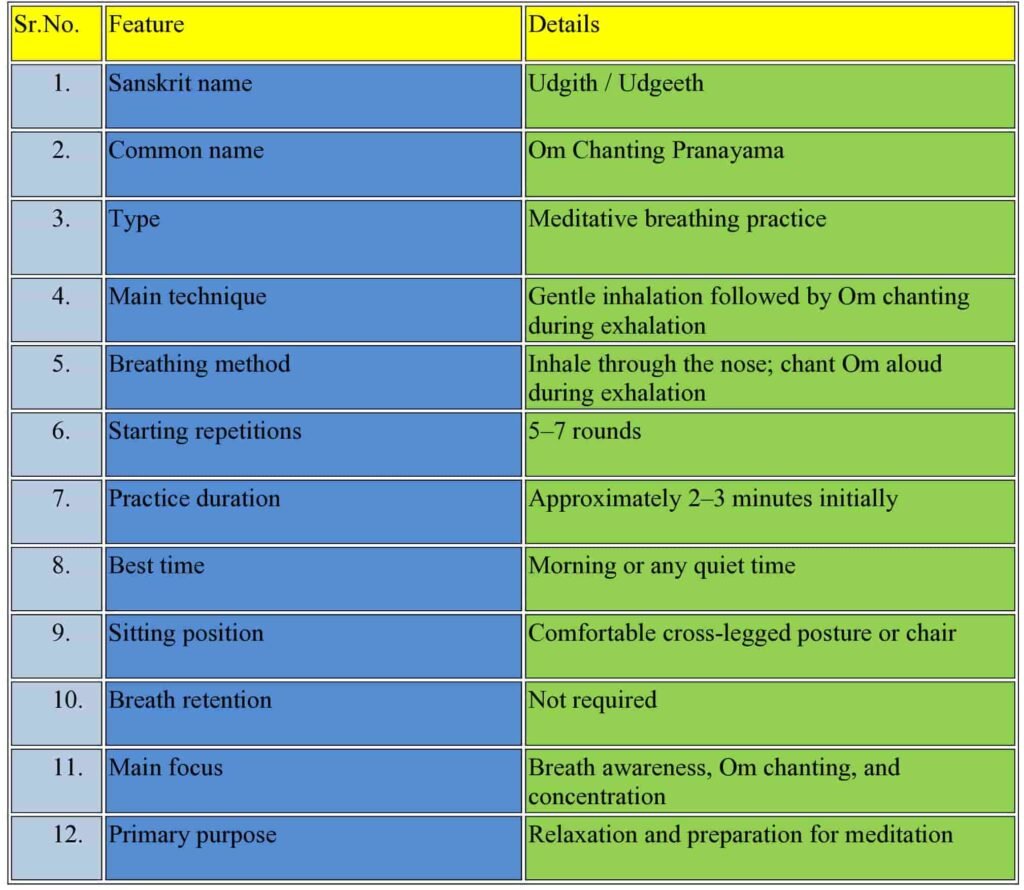
Udgith Pranayama at a Glance
Benefits of Udgith Pranayama
Regular practice of Udgith Pranayama may promote mental relaxation, concentration, and increase awareness of breathing.
1. Promotes Mental Relaxation and Stress Management
Breathing slowly and focusing on Om can help calm scattered thoughts, encourage relaxation, and support the management of daily stress.
2. Improves Concentration and Attention
Over time, listening to and chanting ‘Om’ creates a focal point for attention, which can help in building concentration.
3. Encourages Emotional Awareness
This practice provides an opportunity to calmly observe thoughts and emotions in the mind, which may help in achieving greater emotional awareness.
4. Develops Breath Awareness
Focusing on inhalation and exhalation encourages awareness of the natural rhythm of breathing.
5. Supports Meditation
Repeatedly chanting ‘Om’ and then observing a period of silence can help prepare the mind for meditation.
6. May Promote Relaxation Before Sleep
Gentle practice in the evening can help in calming the mind and creating a peaceful environment before sleep.
Individual experiences may vary. Udgith Pranayama should be considered as a complementary wellness practice, not as a treatment for any medical conditions.
What Does Scientific Research Say About Om Chanting and Pranayama?
Modern research has begun to investigate the potential effects of ‘Om’ chanting and practicing yogic breathing on brain activity, the nervous system, and psychological well-being.
A 2025 narrative review published in Advances in Mind-Body Medicine, titled Physiologic Effects of Om Chanting: A Narrative Review, examined 21 studies. The review discussed potential effects of Om chanting on brain activity, autonomic nervous system function, emotional processing, relaxation, and stress. However, the authors emphasized the need for further basic and clinical research.
Another 2025 review, Tradition, Science and Practice of Om Dhyana (Meditation): A Comprehensive Review, examined 20 studies. Researchers reported potential improvements in relaxation, brain activity, cognitive function, and heart rate variability. However, 18 out of the 20 studies involved interventions lasting three days or less, and the overall quality of this evidence has been assessed as fair. As a result, the long-term effects have not yet been definitively established.
Although research on pranayama has produced encouraging findings, the evidence is still at an early stage. A 2025 systematic review and meta-analysis titled Effectiveness of pranayama for mental disorders, included seven publications reporting six randomized controlled trials (RCTs) involving 517 participants with mental health issues. The meta-analysis found short-term improvement in symptom severity compared with passive control groups, although, the certainty of this findings is limited by the high risk of bias in four of the six trials. This led the researchers to recommend further studies.
These findings suggest that Om chanting and certain yogic breathing practices may support relaxation and mental well-being, although the available studies do not establish the effects of Udgith Pranayama specifically. Further large-scale, high-quality research is needed to confirm whether these findings apply to Udgith Pranayama and whether any effects are sustained over time.
Importantly, these studies do not establish that Udgith Pranayama can treat or cure any specific medical condition. It is best viewed not as a substitute for professional medical care, but rather as a complementary practice for well-being and meditation.
Relationship Between Pranava Pranayama and Udgith Pranayama
Both Udgith Pranayama and Pranava-related practices are associated with the sacred sound Om. Udgith Pranayama and Pranava Pranayama are clearly associated with one another in the Chandogya Upanishad (1.5.1). In contemporary Yoga teachings, Udgith and Pranava related practices may be taught with different importance, such as audible Om chanting, meditation on Om or breath coordination. However, the terminology and methods can overlap and vary across yoga traditions and teachers.
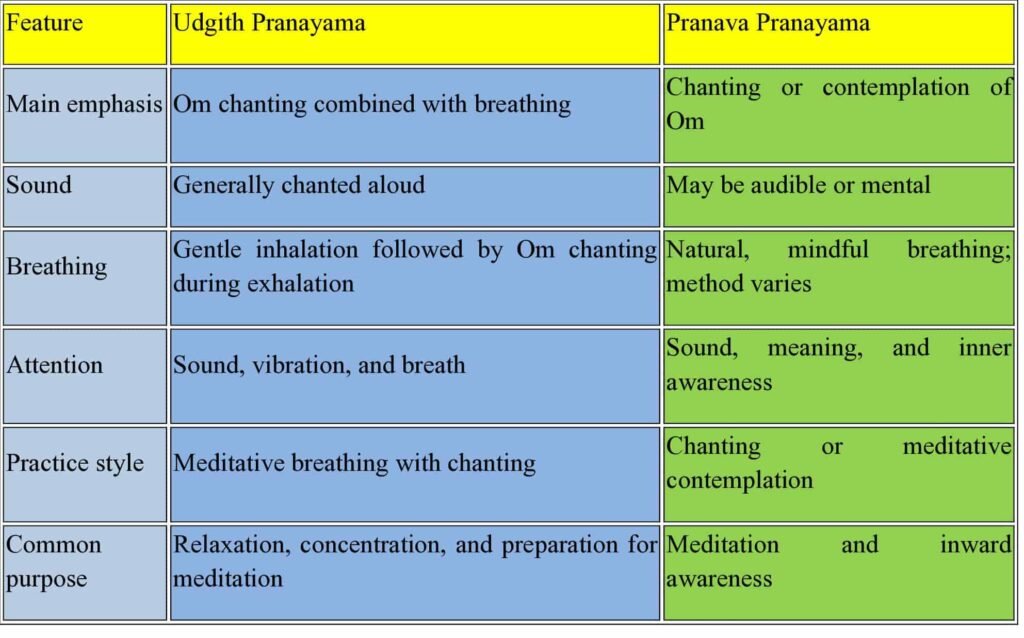
These descriptions show general perspectives rather than universally fixed definitions. In some yogic traditions, Udgitha and Pranava are used in close association; therefore, the precise distinction between them depends on which teaching tradition is being followed.
Difference Between Udgith Pranayama and Bhramari Pranayama
Udgith Pranayama and Bhramari Pranayama are both meditative breathing practices that use sound during exhalation. However, they differ in the type of sound produced and the way attention is directed.
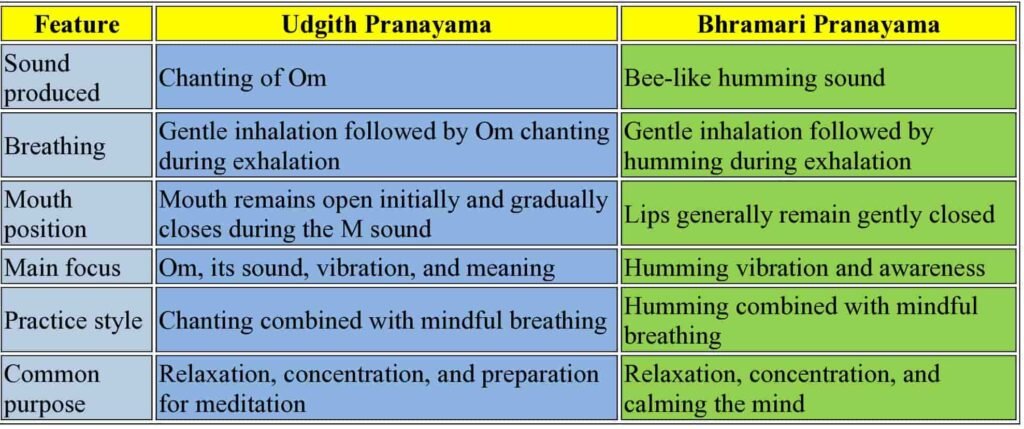
In simple terms, Udgith Pranayama involves the use of the sound ‘Om’, whereas in Bhramari Pranayama, a continuous, humming sound, similar to the buzzing of a bee, is produced. Both practices should be performed gently without any force on the breath or any pressure applied to the voice.
Precautions While Practicing Udgith Pranayama
Udgith Pranayama is generally a gentle practice, but it should always be performed comfortably and without straining. Keep the following precautions in mind:
- Start gradually: The number of rounds should be increased only as you become more comfortable and familiar with the practice; for beginners, it is advisable to start with 5–7 rounds.
- Avoid forced breathing: Inhale and exhale naturally. Do not forcefully draw in air or prolong the exhalation beyond your capacity.
- Do not hold your breath: In the initial stages of this pranayama, there is no requirement to hold your breath.
- Choose a comfortable posture: Keep your spine naturally straight so that no strain occurs on your neck, shoulders, or back.
- Avoid excessive volume: Chant ‘Om’ in a gentle and comfortable tone. There is no need to chant it loudly or with excessive force.
- Stop if you feel discomfort: If you experience dizziness, shortness of breath, chest discomfort, or any other unusual discomfort, stop the practice immediately and return to normal breathing.
- Take extra care with existing health conditions: People with respiratory or cardiovascular conditions, or those recovering from surgery, should seek advice from a qualified healthcare professional before starting a new breathing practice.
- Practice in a peaceful environment: Choose a space that is clean and has adequate ventilation, where you can practice this breathing exercise comfortably without any unwanted interruptions.
Common Mistakes to Avoid While Practicing Udgith Pranayama
Although Udgith Pranayama is very simple to learn, beginners make mistakes that affect concentration and experience.
1. Pronouncing Om Incorrectly
Do not chant Om in a hurried manner. Instead of pronouncing A, U, and M as three separate sounds, blend them together smoothly.
2. Ignoring the Silence After Chanting
Do not rush into the next step. Take some time – observe the silence and start with the natural rhythm of breathing. Keep your attention focused on breathing.
3. Expecting Immediate Results
Do not expect dramatic changes after just a few sessions; instead, continue with regular practice, as relaxation and concentration develop gradually.
Is Udgith Pranayama Really Pranayama or Guided Meditation?
In general, Udgith Pranayama is considered a meditative pranayama practice rather than guided meditation.
The word pranayama refers to a yogic breathing practice involving the regulation of breath and refinement of prana, the life force. In udgith pranayama, the practitioner gently inhales with awareness and then starts chanting Om while exhaling. Therefore, conscious breathing is an essential part of the practice.
Simultaneously, repeated chanting of Om needs focused attention. The practitioner observes the resonating sound, its vibration, awareness of breath and silence that follows. This way of doing breathing makes Udgith Pranayama different from other pranayama practices, where the main focus is on maintaining a breathing pattern.
Guided meditation involves guidance or instructions from an external source. Usually, in guided meditation, the practitioner follows the instructions from an instructor or recorded instructions to develop visualization, which leads to relaxation and awareness. Udgith Pranayama, does not require external instructions or guidance; it can be practiced independently after learning the method.
In conclusion, Udgith Pranayama is best described as a meditative breathing practice that connects pranayama with conscious Om chanting.
Frequently Asked Questions About Udgith Pranayama
Can beginners practice Udgith Pranayama?
Yes, in general, Udgith Pranayama is suitable for beginners as it involves Om chanting with gentle breathing. At the beginning, the practitioner can start with 5-7 comfortable rounds without forceful breathing.
Can I practice Udgith Pranayama every day?
Yes, udgith pranayama can be practiced every day; regular, comfortable breathing is preferred rather than long, forceful breathing.
Can Udgith Pranayama be practiced after meals?
Avoid practicing Udgith pranayama immediately after a heavy meal. Wait at least 2-3 hours after a heavy meal before practicing. Even during gentle practice, stop if you experience stomach discomfort or breathlessness.
Should Om be chanted aloud or mentally during Udgith Pranayama?
Traditionally, the Om syllable is chanted aloud during gentle exhalation. The sound helps the practitioner focus on the chant and its vibrations. Mental chanting is used in some meditation techniques, but the traditional Udgith Pranayama method described here involves audible chanting.
Is Udgith Pranayama beneficial before sleep?
A relaxed mind can support better sleep, and Om chanting may help settle the mind and encourage relaxation. Comfortable practice in a quiet environment is recommended.
What is the difference between Udgith and Bhramari Pranayama?
Both practices involve producing a sound during gentle exhalation, but Udgith Pranayama uses Om chanting, whereas Bhramari Pranayama uses a gentle humming sound.
What is the best time to practice Udgith Pranayama?
Early morning is a popular time for yoga and pranayama. However, you can practice Udgith Pranayama at any time when you feel comfortable.
Conclusion
Udgith Pranayama involves gentle, conscious breathing along with Om chanting and awareness. This simple pranayama practice may support relaxation, concentration and preparation for meditation.
Beginners can start with a few comfortable rounds, avoiding strained breathing or excessively prolonged chanting of Om. Patience and regular practice are of more importance than the number of repetitions.
Disclaimer
The information in this article is intended for educational purposes only and should not be considered medical advice. Udgith Pranayama is not a substitute for medical treatment. If you have a health condition or experience discomfort while practicing, consult a qualified healthcare professional.
About the Author
Yogacharya Dhruv Ji is a Yoga Teacher and practitioner committed to preserving and sharing the authentic wisdom of traditional Yoga and Kriya Yoga. Dhruv Ji received his training in Yoga and Kriya Yoga under the esteemed guidance of Swami Birajananda Giri Maharaj, a revered spiritual teacher known for his deep understanding of yogic philosophy, meditation, and the ancient practices of self-realization.