
Sarvangasana: Benefits, Steps, Precautions & Beginner Guide
Sarvangasana is one of the best-known inverted postures in Yoga. It is commonly known as Shoulder Stand or Shoulderstand.
The name Sarvangasana comes from the Sanskrit words Sarva, meaning “all”, Anga, meaning “limb” or “part of the body”, and Asana, meaning “posture” or “seat”. The name therefore suggests a posture involving the whole body.
To enter Sarvangasana, the practitioner begins supine and gradually raises the lower body until the pelvis is elevated. The hands are then used to steady the trunk while the shoulders and upper arms remain grounded. The legs are extended upward and the body is held in an inverted position.
Sarvangasana has an important place in several Yoga traditions. It requires balance, body awareness, controlled breathing, and careful alignment. At the same time, it is not a posture that everyone should practise.
Because the shoulders and upper arms provide the main support while the neck must remain in a controlled position, Sarvangasana should be approached gradually. Beginners should learn the posture properly rather than trying to hold it for a long time.
This guide explains what Sarvangasana is, its traditional benefits, how to approach the posture, how long to hold it, who should avoid it, and answers common questions about weight loss, anxiety, insomnia, hair growth, blood pressure, menstruation, pregnancy, and its counterpose.
What Is Sarvangasana?
Sarvangasana is a controlled inversion that requires coordinated support from the shoulders, upper arms, hands, trunk, hips, and legs.
Unlike simply lifting the legs above the head, the posture requires the practitioner to maintain stability while keeping the neck still and avoiding unnecessary pressure through the head and cervical spine.
The exact technique can differ slightly between Yoga traditions and teaching lineages. For this reason, a practitioner should learn the method being taught rather than combining instructions from different sources.
What Does Sarvangasana Mean?
The word Sarvangasana is commonly understood as:
- Sarva — all
- Anga — limb or part of the body
- Asana — posture or seat
Sarvangasana is commonly explained from sarva (“all”), anga (“limb” or “part of the body”), and asana (“posture” or “seat”), giving the commonly used sense of “all-limbs pose” or “whole-body posture.”
Its Sanskrit name conveys the idea of a posture in which the body’s different parts work together as one coordinated position. It should not be interpreted as a claim that the posture medically treats every part of the body.
What Is Another Name for Sarvangasana?
Sarvangasana is commonly called:
Shoulder Stand or Shoulderstand.
These names describe the general form of the posture, in which the shoulders and upper arms provide the main support while the body is lifted vertically.
Benefits of Sarvangasana
Sarvangasana is a demanding Yoga posture that combines physical control, balance, concentration, and careful coordination. Traditional Yoga teachings also associate it with a range of broader effects, although these claims should be distinguished from findings established through modern research.
Develops body awareness
Sarvangasana requires the practitioner to pay attention to the position of the shoulders, elbows, hands, spine, hips, and legs while maintaining an inverted position. Learning to coordinate these parts can develop greater awareness of body position and movement.
Develops balance and postural control
Maintaining Sarvangasana requires the body to remain stable while the centre of mass is positioned differently from ordinary standing or seated postures. Maintaining Sarvangasana requires balance, coordination, and control while the body is inverted. Practising the posture can therefore provide experience with these physical demands.
Engages the shoulders, arms and trunk
The shoulders and upper arms provide an important part of the support for the posture, while the trunk and legs contribute to maintaining the position. Sarvangasana therefore requires active muscular engagement rather than simply placing the body upside down.
Encourages concentration
An inversion requires sustained attention to alignment, breathing, balance, and movement. This can make concentration an important part of the practice.
Develops steadiness
Holding a demanding posture without unnecessary movement requires physical and mental steadiness. For this reason, Sarvangasana is traditionally practised not only as a physical position but also as an exercise in maintaining controlled attention.
Encourages awareness of breathing
Breathing should remain comfortable and unforced while practising Sarvangasana. Paying attention to the breath can help the practitioner recognise unnecessary tension and avoid turning the posture into a competition for holding time.
Provides experience with inversion
Sarvangasana introduces the practitioner to an inverted body position in which the shoulders and upper arms provide support. For an appropriately prepared practitioner, this can develop familiarity with the balance and spatial awareness required by inversions.
May feel calming for some practitioners
Some people experience a sense of quiet or relaxation after a slow, attentive Yoga practice. Sarvangasana may be included within such a practice, particularly when followed by rest or other calming practices.
This should not be interpreted as evidence that Sarvangasana treats anxiety, insomnia, or another mental-health condition.
May support a broader Yoga practice
Sarvangasana can form part of a wider Yoga sequence that includes preparation, other asanas, breathing practices, relaxation, or meditation. Its value therefore does not have to be judged in isolation from the rest of the practice.
Has traditional health associations
Traditional Yoga teachings have associated Sarvangasana with various physiological effects, including effects related to circulation, digestion, and the thyroid or throat region. These are traditional associations rather than established medical effects of Sarvangasana itself.
Research on Yoga interventions has reported potential effects on some health outcomes, including thyroid-related measures. However, such studies generally examine broader Yoga programs involving multiple practices rather than Sarvangasana alone. Systematic reviews have also highlighted differences in study design and the need for larger, higher-quality trials before firm conclusions can be drawn.
What Sarvangasana Has Not Been Proven to Do
Sarvangasana should not be presented as a proven treatment for:
- thyroid disease
- high blood pressure
- anxiety
- insomnia
- hair loss
- obesity or weight gain
- cardiovascular disease
For example, research reviews have found potentially beneficial effects from Yoga programs in people with hypothyroidism, but the interventions commonly combine asanas with practices such as Pranayama, meditation, relaxation, or other Yoga techniques. This does not establish Sarvangasana by itself as a treatment for hypothyroidism.
The same principle applies to other health claims: evidence that Yoga as a whole may help with a particular outcome should not automatically be used to claim that one individual asana produces that medical effect.
Traditional Benefits vs Evidence-Based Claims
A useful way to understand Sarvangasana is to keep three categories separate:
Traditional Yoga descriptions explain how different Yoga schools understand the posture and its effects.
Direct physical effects of the posture include the need for balance, muscular control, concentration, and coordinated breathing.
Medical claims require evidence from appropriate clinical research and should not be inferred simply from traditional descriptions.
Sarvangasana can therefore be valuable as a Yoga practice without requiring exaggerated claims about what the posture can medically treat.
Sarvangasana in Traditional Yoga
Sarvangasana holds an important place in several modern Yoga traditions, particularly in systems that developed detailed sequences of inverted postures. Its role, preparation, duration, and method of practice can vary between schools and lineages.
The posture is sometimes given the traditional honorific “Queen of Asanas,” a description of its importance in certain Yoga teachings rather than a scientific ranking.
Why Is Sarvangasana Traditionally Called the “Queen of Asanas”?
Sarvangasana is traditionally given a position of importance in some Yoga teachings because of the combination of its physical demands, inverted orientation, concentration requirements, and place within certain Yoga sequences.
The phrase “Queen of Asanas” is therefore best understood as an expression of traditional respect for the posture.
It does not mean that:
- Sarvangasana is the best Yoga posture for everyone
- every practitioner needs to practise it
- it provides every possible health benefit
- other asanas are less valuable
- the posture should be held for a particular length of time
The suitability of an asana depends on the practitioner, the teaching tradition, the purpose of the practice, and the person’s physical circumstances.
Sarvangasana and Hatha Yoga Traditions
Sarvangasana is particularly prominent in several modern Hatha Yoga teaching traditions. Over time, different schools and teachers incorporated the posture into their own systems of practice, giving it different roles within sequences and teaching methods.
Its prominence in modern Hatha Yoga should not be taken to mean that every historical Yoga tradition taught Sarvangasana in the same way. Yoga developed through different texts, teachers, schools, and lineages, and modern approaches to the posture reflect that diversity.
Is Sarvangasana an Ancient Classical Yoga Posture?
The history of Sarvangasana needs some care because “Yoga” is not a single, unchanged system stretching back unchanged to antiquity.
Earlier Yoga texts often emphasised meditation, discipline, breath, and liberation, while the extensive catalogues of physical postures familiar in modern Yoga became more prominent in later Hatha Yoga and subsequent traditions.
Detailed descriptions of many physical asanas became increasingly prominent in later Hatha Yoga literature and subsequent Yoga traditions.
Sarvangasana became particularly influential in modern Yoga teaching, where it was incorporated into structured asana systems and sequences.
For this reason, it is better to avoid presenting Sarvangasana as though its modern form and teaching method were identical across all historical periods of Yoga.
Why Different Traditions Teach Sarvangasana Differently
There is no single universally accepted technique for every aspect of Sarvangasana.
Differences may include:
- how the practitioner enters the posture
- the position of the elbows and hands
- whether folded blankets are used
- the degree of shoulder elevation
- how vertical the body should become
- how long the posture is held
- which postures are practised before or after it
- which counterpose is used
- whether modifications are taught to beginners
When learning Sarvangasana, it is therefore preferable to follow one coherent method from a qualified teacher rather than combining isolated instructions from different Yoga systems.
Sarvangasana as Part of a Larger Practice
Sarvangasana is better understood as one component of a broader Yoga practice rather than as an isolated exercise.
Depending on the tradition, a practice may include preparation, standing or seated asanas, inversions, counterposes, Pranayama, relaxation, or meditation.
The exact sequence varies considerably.
For a beginner, the most important principle is not to reproduce an advanced traditional sequence immediately. The practice should be adapted to the practitioner’s present level of preparation and ability.
Traditional importance does not remove the need for appropriate technique and safety.
How to Do Sarvangasana
Sarvangasana is an inversion that requires more control than many basic Yoga postures. The shoulders and upper arms support the body, while the neck should remain comfortable and free from unnecessary pressure.
For beginners, it is better to learn the posture gradually rather than trying to lift the whole body into the final position on the first attempt.
Preparation Before Sarvangasana
Practise on a firm, non-slip surface. A few gentle preparatory movements can help warm the shoulders, back and hips. Bridge Pose and other simple movements that prepare the shoulders and core can be useful before attempting the full posture.
A folded blanket setup is traditionally used in some methods of teaching Sarvangasana. The shoulders and upper back rest on the folded blankets, while the head and neck remain on the floor. The purpose is to give the shoulders some additional height and reduce excessive flexion of the neck.
The blanket should support the shoulders, not the head or neck.
If you are learning Sarvangasana for the first time, it is preferable to practise with a qualified Yoga teacher who can check your alignment.
Why Shoulder and Neck Position Matter in Sarvangasana
Sarvangasana is often described as a shoulder-supported inversion because the shoulders and upper arms provide the main support for the lifted body. The head and neck remain on the floor, but they should not be treated as the primary weight-bearing structures.
The position of the shoulders also affects the angle of the neck. In methods that use folded blankets, the shoulders and upper back are raised slightly while the head remains on the floor. This can create more space around the neck and reduce excessive cervical flexion compared with practising without appropriate shoulder elevation.
The purpose of the blanket is therefore not simply to make the posture more comfortable. It can also help create a more suitable relationship between the shoulders, upper back, and neck. The exact setup varies between Yoga traditions, so blanket height and placement should follow the method being taught.
Several points are particularly important:
- Support comes through the shoulders and upper arms: The body should not be balanced by pressing heavily through the head or neck.
- The neck should remain controlled: Avoid deliberately forcing the chin toward the chest or pressing the back of the neck into the floor.
- The head should remain still: Once inverted, do not turn the head from side to side.
- The elbows should provide a stable base: Excessive spreading of the elbows can make it harder to support the torso securely.
- A perfectly vertical body is not the priority: A stable, comfortable position is more important than forcing the legs into a straight line.
These details explain why Sarvangasana should be learned as a supported and controlled posture rather than simply as an attempt to lift the legs above the head.
Step-by-Step Method
- Lie on your back
Lie comfortably on your back with the legs together or naturally aligned. Keep the arms beside the body and allow the neck to remain relaxed.
If using folded blankets, position yourself so that the shoulders and upper back are supported while the head remains on the mat.
- Lift the legs and hips with control
Gently raise the legs and bring the hips upward. As the pelvis lifts away from the floor, use the hands to support the back.
Do not swing the legs or use sudden momentum. The movement should remain controlled.
- Support the back
Bend the elbows and place the hands against the back for support. Keep the elbows reasonably close to one another rather than allowing them to spread widely.
The hands help support the torso, but the posture should not become an attempt to balance the entire body on the hands.
- Bring the body toward vertical
Gradually extend the legs upward. Aim for a comfortable alignment in which the hips move toward being over the shoulders and the feet over the hips.
You do not need to force the legs into a perfectly vertical position if doing so causes strain.
The important point is that the body is supported steadily rather than held through excessive effort.
- Keep the weight away from the head and neck
The main support should come through the shoulders and upper arms.
The head remains on the floor, but it should not become a weight-bearing point. Avoid pressing the neck forcefully into the mat or trying to create the posture by pushing the chin aggressively toward the chest.
A comfortable neck is more important than achieving a perfectly straight body line.
- Keep the elbows stable
The elbows should remain stable enough to create a firm base. If they move too far apart, the upper body may become less stable and the hands may struggle to support the back effectively.
Use only as much muscular effort as necessary to maintain the position.
- Keep the gaze still
Once the body is inverted, keep the head still and look upward.
Do not turn the head from side to side while in Sarvangasana.
Even a small movement of the head can change the position of the neck while it is already under load.
- Breathe naturally
Continue slow, comfortable breathing. Do not deliberately hold the breath to remain in the posture longer.
If breathing becomes difficult, strained or irregular, reduce the duration or come out of the pose.
- Come out slowly
The exit is part of the posture and should be controlled.
Bend the knees if necessary and gradually lower the hips. Continue lowering the back toward the floor rather than dropping suddenly.
Keep the head still until the body has returned to a comfortable position.
After coming down, rest quietly for a few breaths before moving into the next posture.
How Long Should You Hold Sarvangasana?
There is no single holding time that is appropriate for everyone.
For someone learning the posture, a short hold is enough. Some modern instructional sources suggest beginning with roughly 15–30 seconds and increasing gradually when the posture remains comfortable and well aligned. Other traditional Yoga institutions teach longer holds, sometimes up to one or two minutes or more. The teaching tradition, preparation, experience and individual condition all matter.
For beginners, the goal should not be to remain in Sarvangasana for as long as possible.
Quality of alignment, comfortable breathing and control are more important than duration.
If you experience neck pain, numbness, dizziness, visual changes, headache, unusual pressure around the eyes or difficulty breathing, come out of the posture.
Common Mistakes in Sarvangasana
Avoid these common mistakes:
- Putting excessive weight through the head or neck
- Rotating the head after entering the inverted position
- Allowing the elbows to spread too widely
- Using momentum to lift the hips
- Forcing the legs completely vertical
- Holding the breath
- Trying to stay in the pose despite pain or dizziness
- Using blankets under the head instead of supporting the shoulders
- Coming out of the pose suddenly
Sarvangasana should feel controlled rather than forced.
A Better Beginner Progression
A beginner does not necessarily need to move directly from lying on the floor into the full posture.
A gradual approach can be:
Basic preparation → a partial or supported variation → supported Sarvangasana → full Sarvangasana when appropriate
This progression allows the practitioner to develop shoulder strength, core control, balance and familiarity with the inverted position before attempting a longer or more demanding hold.
If the full posture is uncomfortable or unsuitable, a gentler alternative such as Viparita Karani, Supported Bridge Pose or another supported posture may be more appropriate.
The purpose of progression is not to reach the final form quickly. It is to develop enough control to practise without unnecessary strain.
Common Sarvangasana Variations
Sarvangasana can be modified or progressed in several ways depending on the practitioner’s experience, the Yoga tradition being followed, and the purpose of the practice. Not every variation is appropriate for beginners.
Supported Sarvangasana
In a supported approach, folded blankets or other suitable props may be placed beneath the shoulder area to create a more stable setup before entering the pose. This is not necessarily an easier version; the main purpose of the support is to help create an appropriate relationship between the shoulders, upper back, and neck.
Wall-Supported Sarvangasana
A wall may be used in some teaching methods as an aid for learning or modifying the inversion. The exact method varies between traditions, and wall support should not replace proper instruction in shoulder and neck alignment.
Eka Pada Sarvangasana
In Eka Pada Sarvangasana, one leg remains elevated while the other leg moves away from the vertical position. The variation increases the balance and control required and is generally more appropriate for practitioners who are already comfortable with the basic Sarvangasana.
Niralamba Sarvangasana
Niralamba Sarvangasana is an unsupported variation in which the hands do not provide the usual support to the back. It requires substantially greater balance, strength, and control than the supported form and is an advanced variation rather than a beginner progression.
The basic Sarvangasana should be established before attempting more demanding variations. A variation should increase the quality and purpose of the practice, not be used simply to make the posture more difficult.
Is Sarvangasana Suitable for Beginners?
Sarvangasana is not usually the first inversion a complete beginner should attempt without instruction.
Although the posture may look simple, its alignment requires understanding. A beginner may not easily recognise whether too much pressure is being placed on the neck or whether the shoulders and arms are providing adequate support.
A beginner can first develop familiarity with simpler Yoga postures and movements before learning Sarvangasana.
Yoga Asanas are best approached gradually, with attention to steadiness, breathing, and the body’s present ability. You can explore the broader principles of beginning Yoga in our [Yoga Asanas guide].
Who Should Avoid or Modify Sarvangasana?
Sarvangasana is not suitable for everyone, particularly when an inversion or the required neck and shoulder position conflicts with an individual’s health or physical limitations.
Extra caution is appropriate for people with:
- a neck or cervical spine problem
- a significant shoulder injury
- recent surgery
- certain eye conditions, particularly glaucoma or elevated intraocular pressure
- uncontrolled high blood pressure
- certain cardiovascular conditions
- serious balance problems
- any other condition for which an inversion has been advised against
If you experience neck pain, dizziness, unusual pressure, breathing difficulty, or another concerning symptom, come out of the posture.
If you are unsure whether Sarvangasana is appropriate for you, seek guidance from an appropriate healthcare professional and a qualified Yoga teacher.
Sarvangasana and High Blood Pressure
Sarvangasana should not be used as a treatment for high blood pressure.
Inversions can affect the cardiovascular system, and whether they are appropriate depends on the person’s health and circumstances.
If you have high blood pressure, especially if it is not well controlled, seek medical advice before practising Sarvangasana or other demanding inversions.
Do not assume that a posture is safe simply because it is traditionally practised in Yoga.
Sarvangasana During Menstruation
Yoga traditions differ in their approach to inversions during menstruation.
Some traditional Yoga schools advise women to avoid inversions during menstruation, while other approaches may allow experienced practitioners to continue when they feel comfortable and have no relevant health concerns.
There is therefore no universal rule that applies to every woman or every Yoga tradition.
If you are new to Sarvangasana, menstruation is not an ideal time to experiment with the posture for the first time.
If you experience pain, weakness, dizziness, heavy bleeding, or significant discomfort, choose rest or a gentler practice instead.
Sarvangasana During Pregnancy
Pregnancy requires additional caution.
Sarvangasana should not be started independently during pregnancy. Pregnancy changes balance, body mechanics, and physical requirements, and the suitability of an inversion can depend on the individual and stage of pregnancy.
If you were already an experienced practitioner before pregnancy, whether you should continue an inversion should be discussed with your obstetric healthcare professional and a qualified prenatal Yoga teacher.
Someone who has never practised Sarvangasana should not use pregnancy as a time to learn it independently.
Gentler and pregnancy-appropriate Yoga practices may provide alternatives without requiring a shoulder stand.
Does Sarvangasana Help With Weight Loss?
Sarvangasana is not a weight-loss exercise by itself.
The pose does involve muscular work, but spending time in a static asana should not be regarded as a standalone strategy for losing body weight.
Healthy weight management involves several factors, including:
- overall physical activity
- food intake
- sleep
- genetics
- metabolism
- individual health conditions
Yoga can be part of an active lifestyle, but Sarvangasana should not be treated as a special technique for burning body fat.
If your goal is weight management, a broader approach to physical activity and overall health is more appropriate.
Can Sarvangasana Cure Insomnia and Anxiety?
It is more accurate to view Sarvangasana as a Yoga posture rather than claim that it can resolve insomnia or anxiety disorders.
A regular Yoga practice may help some people develop relaxation, body awareness, and a calmer routine. Breathing practices and meditation may also be included in a broader practice.
For example, Bhramari Pranayama combines gentle breathing, humming, and focused attention and may be used as part of a quiet routine. It is also not a treatment for sleep disorders.
If insomnia or anxiety is persistent or significantly affects daily life, it is better to seek appropriate professional help rather than relying on Sarvangasana.
Does Sarvangasana Regrow Hair?
There is no reliable evidence that Sarvangasana regrows hair.
A common claim is that being upside down increases blood flow to the scalp and therefore promotes hair growth. Hair loss, however, can have many causes, including genetics, hormonal changes, nutritional deficiencies, medical conditions, medications, and scalp disorders.
Sarvangasana should therefore not be presented as a treatment for hair loss.
If hair loss is persistent or significant, identifying its underlying cause is more useful than relying on an inversion.
Sarvangasana vs Viparita Karani
Sarvangasana and Viparita Karani are both associated with inversion, but they differ considerably in technique, support, and physical demand.
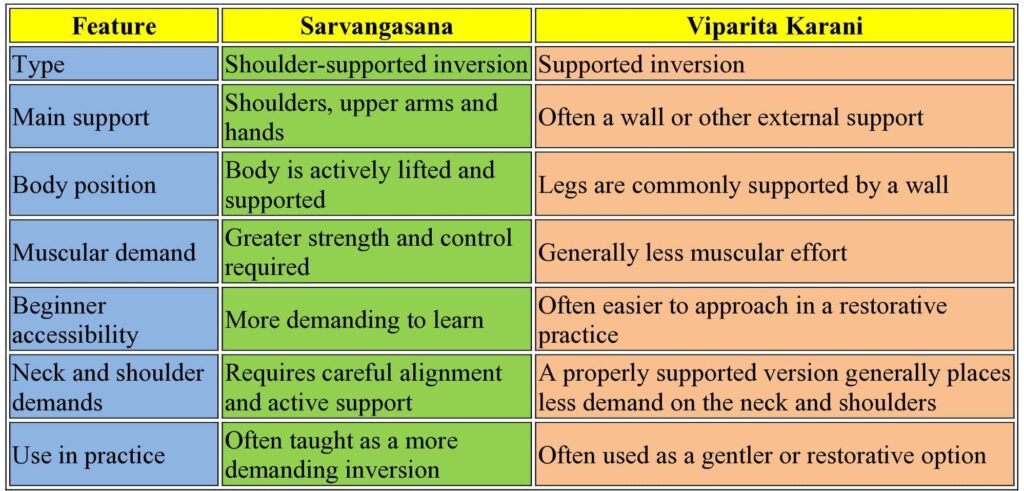
The exact form of Viparita Karani varies between Yoga traditions.
For someone looking for a gentler inversion experience, a supported form of Viparita Karani may be more accessible than Sarvangasana.
Sarvangasana vs Shirsasana
Sarvangasana (Shoulder Stand) and Shirsasana (Headstand) are both inverted Yoga postures, but they differ in how the body is supported and in the technical demands of the practice.
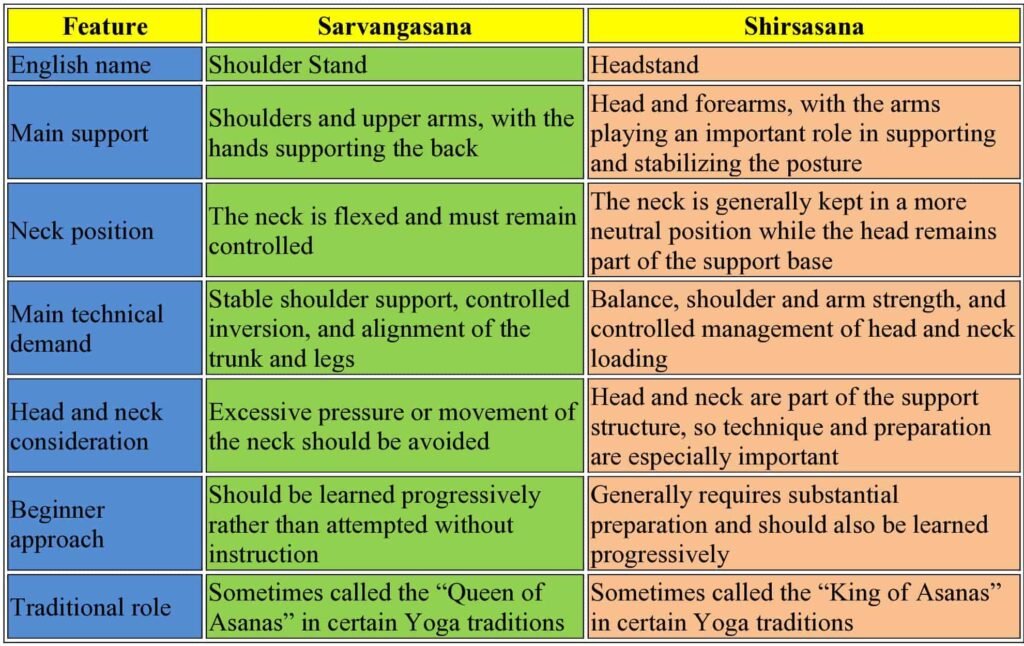
Neither posture should be treated as automatically better or safer for everyone. They have different mechanical demands, and suitability depends on the practitioner’s preparation, physical circumstances, and the method being taught.
Both are demanding inversions and are best learned progressively under appropriate instruction rather than judged by how long they can be held.
Sarvangasana vs Halasana
Sarvangasana (Shoulder Stand) and Halasana (Plow Pose) are closely related inverted Yoga postures and are often taught together in some Yoga traditions. However, their body positions and technical demands are different.
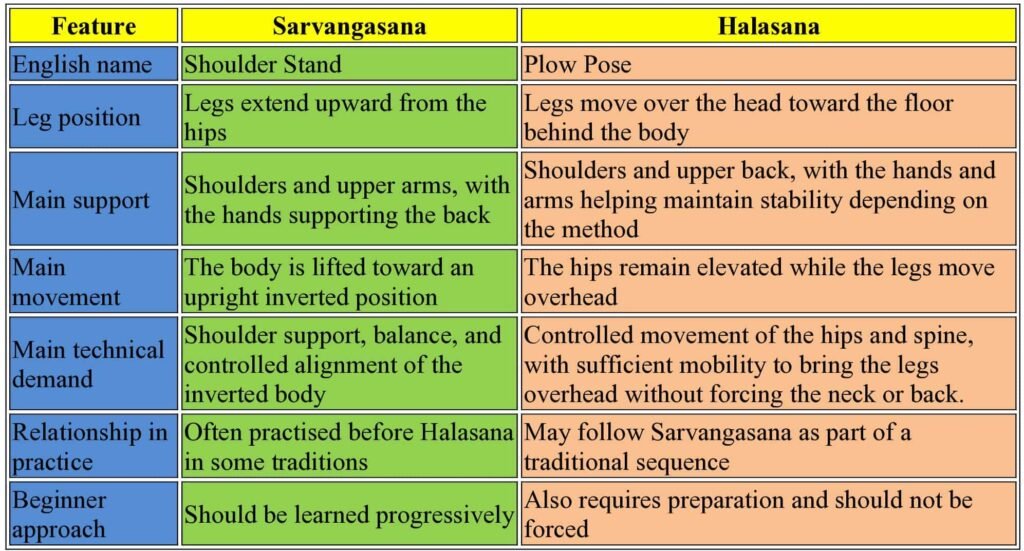
Neither posture should be assumed to be easier simply because the body position is different. Both require appropriate preparation, controlled movement, and attention to the shoulders and neck.
The exact order and use of Sarvangasana and Halasana varies between Yoga traditions and teaching lineages.
Limitations and Considerations of Sarvangasana
Sarvangasana can be a useful Yoga posture for an appropriate practitioner, but it also has practical limitations.
Technically demanding:
The posture requires coordinated control of the shoulders, arms, trunk, hips, and legs. It can be difficult to learn without suitable preparation or instruction.
Requires careful alignment:
The position of the shoulders, elbows, hands, and neck matters. Poor technique can make the posture uncomfortable or increase unnecessary strain.
Not easily accessible to everyone:
Limited mobility, insufficient strength, previous injuries, or difficulty with balance may make the full posture unsuitable or require a supported variation.
Can be uncomfortable for some practitioners:
Some people may experience discomfort around the neck, shoulders, head, eyes, or ears while inverted. These symptoms should not be ignored.
Requires a controlled exit:
Coming out of an inversion too quickly can make the movement unstable. The posture therefore requires attention not only while holding it but also while entering and leaving it.
These limitations do not mean that Sarvangasana is inherently unsuitable. They show why it should be approached as a skilled Yoga posture, with appropriate preparation and attention to individual circumstances.
Frequently Asked Questions About Sarvangasana
How long should I hold Sarvangasana?
There is no single duration suitable for everyone. Beginners should build duration gradually while keeping the breathing comfortable and alignment steady.
Is Sarvangasana suitable for beginners?
Sarvangasana is a demanding inversion and is better learned progressively, preferably with appropriate instruction rather than independently.
Can women practise Sarvangasana during menstruation?
Yoga traditions differ on inversions during menstruation. Beginners should avoid using this time to experiment with Sarvangasana for the first time.
Can women practise Sarvangasana during pregnancy?
Sarvangasana should not be started independently during pregnancy. Anyone considering continuing an inversion should discuss it with an appropriate healthcare professional and qualified prenatal Yoga teacher.
Is Sarvangasana good for high blood pressure?
Sarvangasana should not be used to treat high blood pressure. Anyone with hypertension should seek appropriate medical guidance before practising demanding inversions.
Does Sarvangasana improve thyroid function?
There is not enough reliable evidence to establish Sarvangasana itself as a treatment for thyroid disease. Some studies have reported changes in thyroid-related measures after broader Yoga programs, but these interventions generally involve multiple practices rather than Sarvangasana alone.
If you have a thyroid condition, continue appropriate medical care rather than using Sarvangasana as a treatment. Whether the posture is appropriate for you should also depend on your individual health and the guidance of your healthcare professional and Yoga teacher.
Does Sarvangasana help with weight loss?
Sarvangasana alone is not a reliable method of weight loss. It may be part of a broader Yoga practice, but weight management depends on multiple factors.
Does Sarvangasana regrow hair?
There is no reliable evidence that Sarvangasana regrows hair. Persistent hair loss may have various causes and may require professional assessment.
What is the counterpose of Sarvangasana?
Matsyasana (Fish Pose) is traditionally taught as a counterpose to Sarvangasana in several Yoga traditions, although sequencing and counterpose practices vary between lineages.
Final Thoughts
Sarvangasana is a traditional inverted Yoga posture that combines balance, body awareness, controlled breathing, and careful alignment. It can be a meaningful part of a suitable Yoga practice, but it is not necessary or appropriate for every practitioner.
The most important consideration is not how long you can hold the posture or how perfectly vertical you can make the body. Learn it progressively, respect the requirements of the neck and shoulders, and avoid treating traditional descriptions as medical promises.
When Sarvangasana is appropriate, careful instruction and steady practice can make the posture more comfortable and meaningful. When it is not appropriate, choosing a different posture is equally consistent with practising Yoga with awareness.
Disclaimer
This article is for general educational and informational purposes only. It is not a substitute for medical advice, diagnosis, or treatment. Sarvangasana is not suitable for everyone, and individual practice may need to be modified based on health, physical condition, and experience. If you have a medical condition, are recovering from an injury or surgery, are pregnant, or are unsure whether Sarvangasana is appropriate for you, consult a qualified healthcare professional and, where appropriate, an experienced Yoga teacher before practising.
About the Author
Yogacharya Dhruv Ji is a yoga teacher and practitioner committed to preserving and sharing the authentic wisdom of traditional Yoga and Kriya Yoga. He received his training in Yoga and Kriya Yoga under the guidance of Swami Birajananda Giri Maharaj, a respected spiritual teacher known for his teachings on yogic philosophy, meditation, and the traditional practices of self-realization.