
Paschimottanasana: Benefits, Steps and Precautions
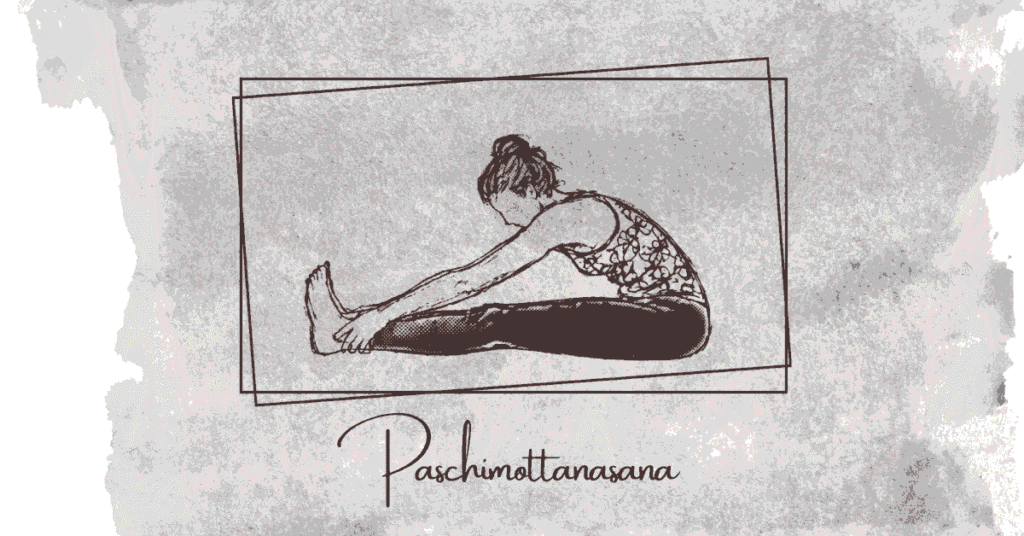
Paschimottanasana, commonly known as Seated Forward Bend or Seated Forward Fold, is a seated Yoga posture in which the legs are extended forward and the torso folds toward the legs.
At first glance, it may look like a simple attempt to reach the feet. But Paschimottanasana is not a test of how far the hands can travel.
The practice is about creating length, moving with awareness, and exploring a forward fold without unnecessary force.
A useful principle is:
Lengthen before you fold.
When the torso is given space before the forward movement begins, the posture becomes less about reaching a final shape and more about observing the relationship between the legs, pelvis, spine, breath, and attention.
You do not need to touch your feet to practise Paschimottanasana. A strap, folded blanket, or slightly bent knees can be appropriate modifications when they help you maintain steadiness and ease.
This guide explains the meaning, traditional context, benefits, steps, breathing, modifications, common mistakes, precautions, back pain, and frequently asked questions about Paschimottanasana.
What Is Paschimottanasana?
Paschimottanasana is a seated forward-folding asana performed with both legs extended in front of the body.
In modern Yoga instruction, the posture is commonly prepared from Dandasana (Staff Pose). From there, the practitioner establishes length through the torso and explores a forward movement from the hips and pelvis.
The hands may rest wherever they comfortably reach—on the thighs, shins, ankles, feet, or a strap around the feet.
The forehead does not need to reach the knees, and the hands do not need to reach the toes. The final shape naturally differs from person to person.
Paschimottanasana at a Glance
- Sanskrit: Paschimottanasana
- Common English name: Seated Forward Bend or Seated Forward Fold
- Type: Seated forward fold
- Starting posture: Dandasana
- Primary areas of sensation: Back of the legs and back of the body
- Common props: Folded blanket and Yoga strap
- Main teaching principle: Lengthen before folding
What matters is not reproducing someone else’s depth but maintaining a steady and conscious relationship between effort and ease.
What Does Paschimottanasana Mean?
Paschimottanasana can be understood through three parts:
- Paścima — west; traditionally associated with the back or posterior side of the body
- Uttāna — intense stretch, extension, or strong lengthening
- Āsana — posture or seat
The name therefore points toward a strong lengthening or stretching of the posterior body.
It is commonly translated into English as Seated Forward Bend or Seated Forward Fold. The Sanskrit name, however, gives more traditional context than the English description alone.
Paschimottanasana in Traditional Yoga
Paschimottanasana is described in the classical literature of Haṭha Yoga.
In its discussion of āsana, the Haṭha Yoga Pradīpikā includes a posture known as Paścimatānāsana, with the name also appearing as Paścimottānāsana in transliteration.
The classical description involves the legs extended on the ground, the hands holding the feet, and the forehead moving toward the knees. The following verse attributes traditional effects to the practice, including changes in the movement of prāṇa and an increase of jaṭharāgni, or digestive fire.
These are traditional Yoga claims, not modern medical findings.
Classical Yoga texts should be understood within the philosophical and energetic framework in which they were written. Modern practitioners may use different techniques, props, ranges of movement, and teaching methods according to their lineage and individual needs.
Classical Paschimottanasana and Modern Practice
The classical description of Paschimottanasana in the Haṭha Yoga Pradīpikā presents a specific form of the posture. Modern Yoga practice, however, may adapt the posture according to the practitioner’s structure, mobility, experience, and teaching method.
These adaptations can include using a folded blanket under the sitting bones, a strap around the feet, slightly bent knees, or a smaller forward fold. Such modifications do not necessarily change the essential purpose of the practice. They can help the practitioner maintain steadiness, awareness, and appropriate effort.
The form may be adapted; the principle remains: practise with awareness rather than force.
Paschimottanasana Benefits
Paschimottanasana is often described simply as a hamstring stretch. Its practice can offer a broader field of physical and attentional awareness.
- Stretches the Back of the Legs
With the legs extended and the torso moving forward, Paschimottanasana commonly creates a sustained stretch through the posterior legs, particularly the hamstrings.
The sensation varies according to flexibility, hip movement, body proportions, and technique.
A strong sensation is not automatically a sign of a better posture. The more useful question is whether the stretch remains manageable while the breath stays steady.
- Develops Awareness of Hip and Pelvic Movement
A forward fold is not simply a movement of the upper body toward the legs. The pelvis participates in the movement.
When the hips and pelvis can move comfortably, the torso can travel forward without relying entirely on spinal movement or pulling with the arms.
A folded blanket under the sitting bones can sometimes make upright sitting easier and help the practitioner explore this movement more clearly.
- Encourages Postural Awareness
Paschimottanasana invites observation of the relationship between the legs, pelvis, spine, shoulders, and breath.
For example, reaching farther with the hands may cause the shoulders to tighten or the spine to round more than feels comfortable.
Rather than treating this as failure, the practitioner can use it as information and adjust the posture.
- Cultivates Steadiness and Patience
Forward folds can tempt the practitioner to chase depth.
Paschimottanasana offers another lesson: lengthen, fold, breathe, observe, and remain where the body can practise without unnecessary strain.
The posture becomes a practice of steadiness rather than comparison.
- Encourages a Quieter, More Inward Practice
The seated shape of Paschimottanasana can naturally encourage a quieter quality of attention.
With smooth breathing and reduced physical effort, the posture may feel more inward and reflective than a dynamic standing sequence.
This is best understood as a traditional and experiential aspect of Yoga practice, not as a medical claim about a particular psychological effect.
What Does Paschimottanasana Stretch?
Paschimottanasana primarily involves the back of the body, especially:
- hamstrings
- calves
- posterior hip region
- muscles along the back of the trunk
The exact sensation depends on how the pelvis, hips, knees, and spine participate in the fold.
If the pelvis moves comfortably, the stretch may be felt predominantly through the back of the thighs. If pelvic movement is limited, the practitioner may compensate by moving more through the spine.
This is why simply saying “keep the legs straight and reach the toes” is incomplete instruction.
The relationship between the legs, pelvis, and spine matters more than the distance between the hands and feet.
Does Paschimottanasana Improve Flexibility?
There is some emerging direct research on Paschimottanasana and flexibility.
A randomized controlled trial published in 2026 included 150 healthy adults aged 18 to 28. Over four weeks, the intervention group practised 16 minutes of Sukshma Vyayama followed by four minutes of Paschimottanasana, six days per week. Compared with the control group, which practised Savasana, the intervention group showed significant improvements in sit-and-reach performance and measured lumbar flexion.
This provides useful evidence that a programme including Paschimottanasana may improve flexibility measures.
However, the study does not establish that Paschimottanasana alone caused every observed change because participants also performed preparatory exercises.
The evidence is therefore encouraging but limited.
How to Prepare for Paschimottanasana
A good starting point is Dandasana.
Sit with the legs extended forward and the feet naturally active. If sitting upright is difficult and the pelvis tends to roll backward, place a folded blanket underneath the sitting bones.
Before folding, ask:
- Can I sit with some length through the spine?
- Are the legs active without unnecessary tension?
- Can I breathe comfortably?
- Can I remain upright without forcing the posture?
Gentle movements of the hips, legs, and spine can also be useful preparation.
The purpose is not to force flexibility before the posture begins, but to make the starting position more stable and understandable.
How to Do Paschimottanasana
Step 1: Start in Dandasana
Sit with both legs extended forward. Keep the legs active without aggressively locking the knees.
Place the hands beside the hips or on the thighs. If the pelvis rolls backward, sit on a folded blanket.
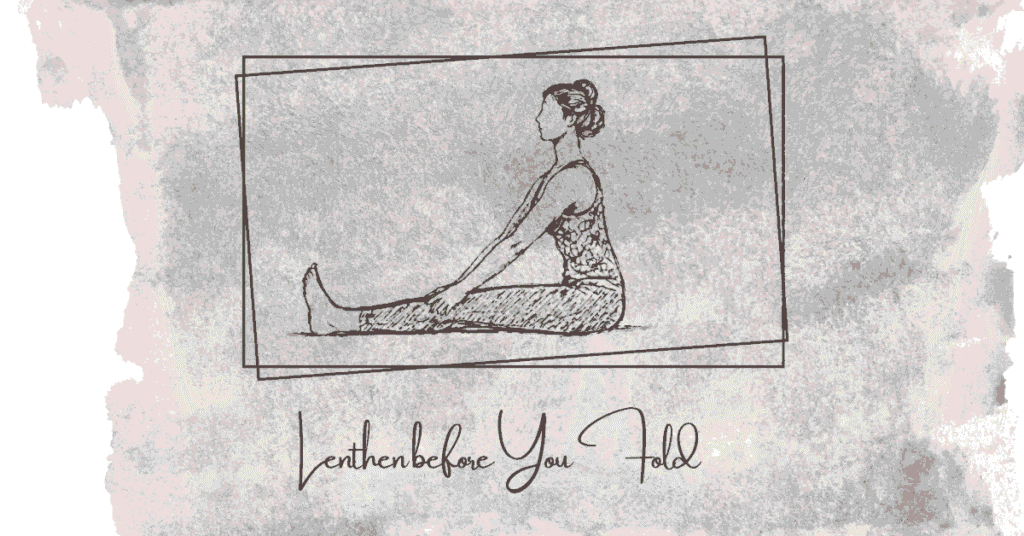
Step 2: Establish Length
Before moving forward, lengthen through the spine and torso.
Allow the crown of the head to rise while the sitting bones remain grounded.
Lengthen before you fold.
Step 3: Hinge Forward From the Hips
As you inhale, create length through the torso.
As you exhale, begin to move forward from the hips and pelvis.
Do not pull the chest toward the knees. Allow the torso to travel forward within a controlled and comfortable range.
Step 4: Place the Hands Where They Reach
Let the hands rest wherever they can reach without disturbing the posture:
- thighs
- shins
- ankles
- feet
- Yoga strap around the feet
There is no requirement to touch the toes.
Step 5: Settle Into the Posture
Once you reach your appropriate range, stop trying to go farther.
Allow the shoulders and arms to soften. Do not use the hands to drag the torso toward the feet.
Keep the breath smooth.
Step 6: Stay With Awareness
Observe the sensations through the legs, hips, back, and breath.
If the body gradually releases some tension, you may naturally move slightly deeper. That movement should come from increased ease rather than force.
Step 7: Come Out Slowly
Release the hands gradually and bring the torso back to an upright seated position with control.
Return to Dandasana or another comfortable seated position and pause for a breath or two.
Breathing in Paschimottanasana
Breathing can provide a simple guide:
Inhale — lengthen.
Exhale — soften into the fold.
The exhalation is not permission to force yourself farther forward.
If the breath becomes shallow, restricted, or strained, reduce the intensity.
Let the breath remain part of the practice rather than treating it as something separate from the posture.
Do You Have to Touch Your Feet?
No.
Touching the feet is not a requirement for Paschimottanasana.
Your hands may remain on your thighs, shins, ankles, or a strap.
Trying to reach the feet at all costs can encourage excessive rounding, pulling with the arms, shoulder tension, or breath-holding.
The feet are not the destination of the posture.
The quality of the fold matters more than the distance travelled.
Should Your Knees Be Straight?
Paschimottanasana is commonly taught with the legs extended, but straight does not mean forcefully locked.
If keeping the knees completely straight creates excessive tension through the back of the legs or makes it difficult to sit steadily, a slight bend can be a useful modification.
A bent knee is not a failure. A modification that allows you to practise with awareness can be more useful than a theoretically perfect position that creates unnecessary strain.
How Far Should You Bend?
There is no single correct depth for Paschimottanasana.
Your appropriate range depends on factors such as flexibility of the posterior legs, hip and pelvic movement, body proportions, previous practice, and current physical condition.
The deepest possible fold is not necessarily the best fold.
Stop where you can maintain awareness, reasonable length, and comfortable breathing. Do not measure progress only by how close the chest or forehead comes to the legs.
How Should Paschimottanasana Feel?
A reasonable experience may include a gradual stretch through the back of the legs and a sense of sustained effort.
Reconsider or come out of the posture if you experience:
- sharp or sudden pain
- strong or increasing lower-back pain
- numbness or tingling
- aggressive pulling
- difficulty breathing
- dizziness or loss of stability
Yoga asks for attention, not endurance of pain.
Using a Blanket, Strap or Other Support
Props are not signs that you are doing a lesser version of the posture. They can help you practise with greater stability and awareness.
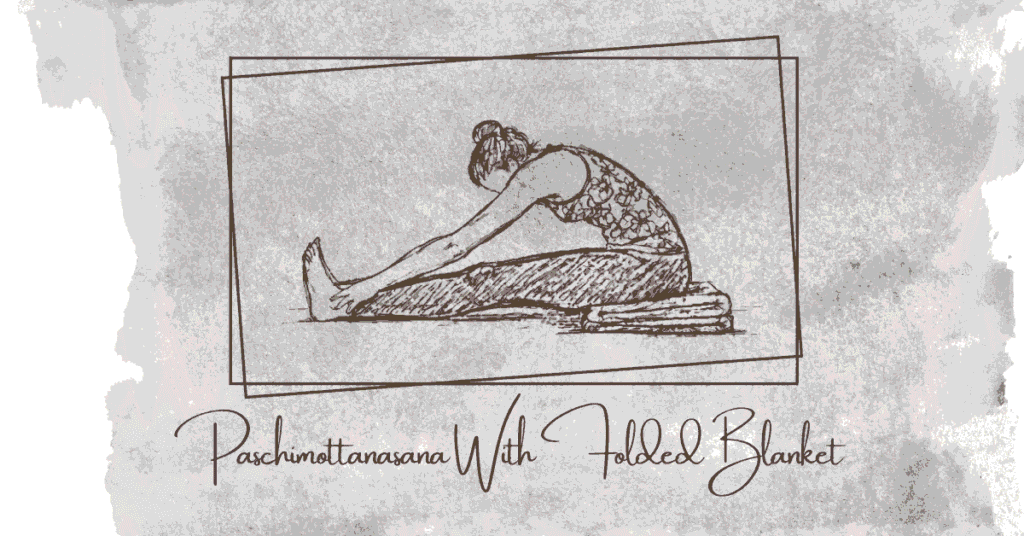
Folded Blanket: A blanket under the sitting bones can make upright sitting easier and may help the pelvis move more comfortably.
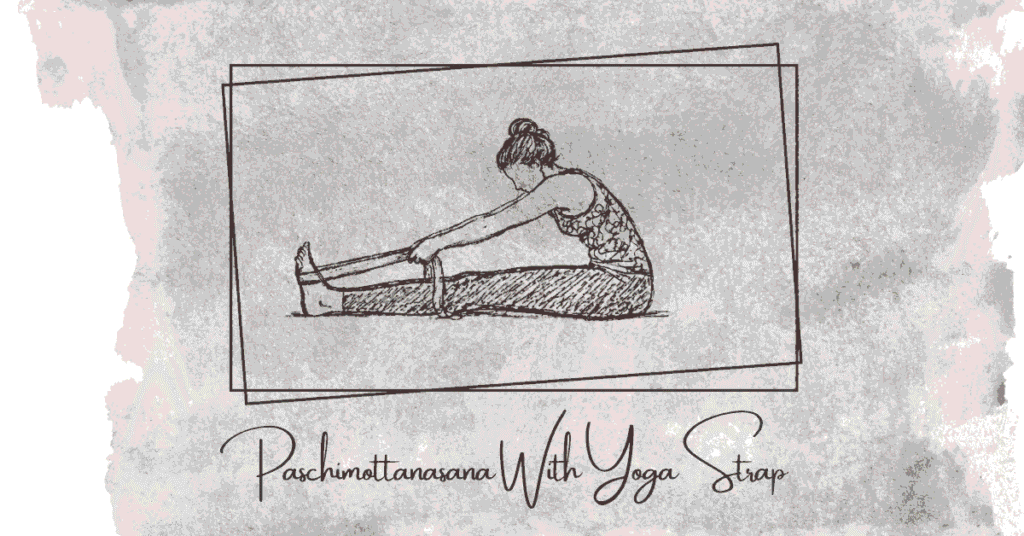
Yoga Strap: A strap around the feet gives the hands something to hold without requiring them to reach the feet. Hold it lightly rather than pulling aggressively.
Bent Knees: Slightly bending the knees can reduce the demand on the posterior legs and help some practitioners maintain a more comfortable relationship between the pelvis and spine.
Support can make the posture more intelligent.
Paschimottanasana for Beginners
If you are new to Paschimottanasana, begin with less depth:
- Sit in Dandasana.
- Use a folded blanket if sitting upright is difficult.
- Establish length through the torso.
- Keep the legs active without force.
- Fold forward only as far as you can maintain reasonable ease.
- Let the hands rest wherever they reach.
- Keep breathing smoothly.
- Come out slowly.
You do not need to become flexible before beginning the posture. The practice itself teaches you about your present range.
How Long Should You Hold Paschimottanasana?
There is no universal holding time that is correct for everyone.
Beginners can start with a relatively short, comfortable hold and gradually increase the duration as the posture becomes familiar.
The quality of the hold matters more than the clock. If staying longer causes the breath to become strained or the body to lose steadiness, a shorter hold may be more appropriate.
Can You Practise Paschimottanasana Every Day?
Paschimottanasana can be included regularly if it feels appropriate for your body and practice.
Daily practice does not mean forcing the posture deeper every day. One day your body may naturally allow more movement; another day it may not.
Consistency is more useful when combined with moderation.
Paschimottanasana and Back Pain
Paschimottanasana should not be presented as a treatment or cure for back pain.
Research on Yoga as a broader practice for chronic nonspecific low-back pain suggests that Yoga may produce small improvements in pain and back-related function compared with no exercise. Evidence also suggests little or no difference in back-related function when Yoga is compared with other back-focused exercise.
Importantly, this research concerns Yoga as a practice, not Paschimottanasana as an isolated posture.
A forward fold may feel comfortable for one practitioner and aggravating for another. If Paschimottanasana increases your back pain, reduce the range or stop rather than pushing through it.
If you have persistent, significant, or unexplained back pain, individualized guidance is more appropriate than relying on general pose instructions.
Paschimottanasana Precautions: Who Should Modify or Avoid It?
Paschimottanasana requires particular care when forward bending or stretching the back of the legs is currently uncomfortable.
Consider modifying the posture or seeking appropriate guidance if you have:
- a recent or significant back injury
- an acute hamstring injury
- pain that becomes worse with forward bending
- recent abdominal surgery
- another condition for which forward bending has been restricted
- significant mobility limitations
- numbness or tingling during the posture
During pregnancy, forward folds may need modification as the body changes. Avoid compressing the abdomen and seek individualized guidance from an appropriately qualified prenatal Yoga teacher or healthcare professional.
Stop the posture if you experience sharp or severe pain, numbness, tingling, or other concerning symptoms. Do not use Yoga to override the signals of the body.
Common Paschimottanasana Mistakes
- Chasing the Feet
Trying to reach the toes can turn the posture into a test of flexibility.
Correction: Keep the hands where they naturally reach.
- Forcing the Fold Deeper
Trying to achieve a dramatic shape can lead to excessive spinal movement or strain.
Correction: Establish length first and work within a controlled range.
- Rounding the Spine Excessively
Some spinal rounding can naturally occur in a forward fold. The problem is forcing the spine deeper simply to make the hands travel farther.
Correction: Reduce the depth and allow movement to remain balanced between the hips and spine.
- Locking the Knees
Forcefully straightening the knees can create unnecessary tension.
Correction: Keep the legs active without aggressively locking them.
- Pulling With the Arms
The arms should not drag the torso toward the feet.
Correction: Let forward movement develop primarily through the hips and pelvis.
- Holding the Breath
Straining often appears first in the breath.
Correction: Reduce the intensity until breathing becomes smooth again.
- Copying Someone Else’s Depth
Two practitioners can have very different ranges while both practising appropriately.
Correction: Work with your own present range.
- Treating Discomfort as Progress
Feeling more does not necessarily mean the posture is benefiting you more.
Correction: Distinguish a manageable stretch from pain or strain.
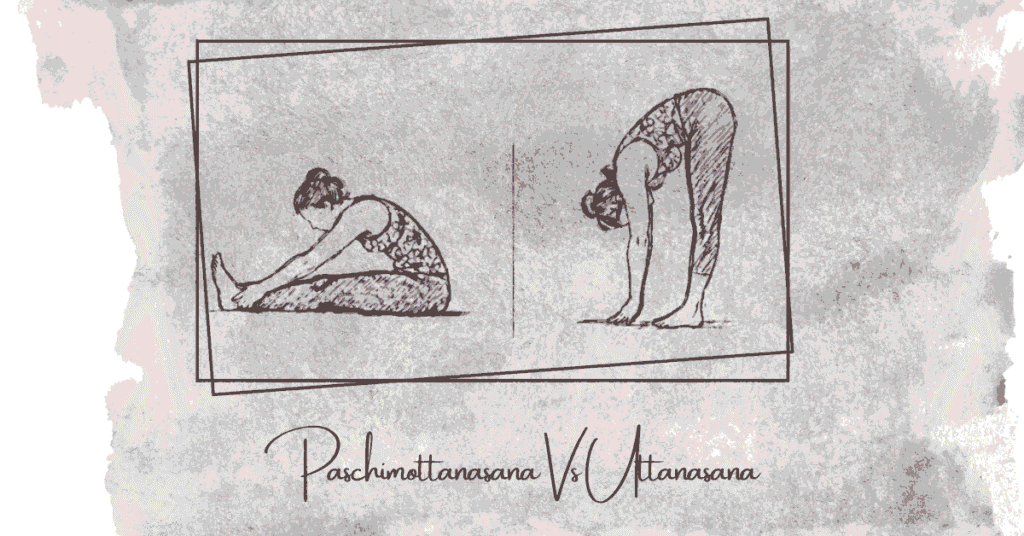
Paschimottanasana vs Uttanasana
Both postures involve forward folding, but their starting positions and relationship with gravity are different.
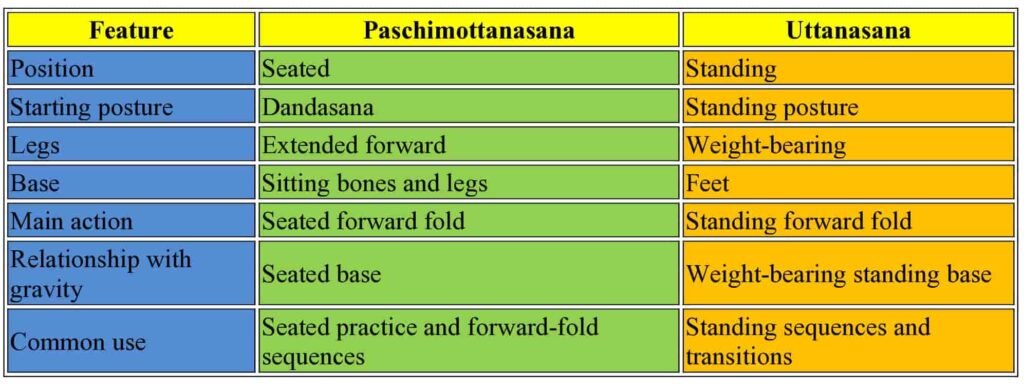
Neither posture is simply the seated or standing version of the other. The different relationship between the pelvis, legs, floor, and gravity makes each a distinct practice.
Can Paschimottanasana Reduce Belly Fat?
No single Yoga posture can selectively reduce abdominal fat.
The Haṭha Yoga Pradīpikā makes traditional statements about digestive fire and the abdomen in relation to Paschimottanasana. These belong to the traditional framework of the practice and should not be presented as modern evidence that the posture burns abdominal fat or causes targeted weight loss.
Changes in body composition depend on broader factors such as overall physical activity, nutrition, sleep, genetics, and energy balance.
Paschimottanasana can be valuable without needing a weight-loss claim.
What Can You Practise After Paschimottanasana?
After Paschimottanasana, return slowly to an upright seated position and take a few natural breaths. You may then continue with a gentle seated or restorative practice, depending on the purpose of your session. There is no single posture that must follow Paschimottanasana.
Frequently Asked Questions
What is the main benefit of Paschimottanasana?
One of its clearest physical effects is stretching the back of the legs, particularly the hamstrings. As a Yoga practice, it also develops awareness of the relationship between the legs, pelvis, spine, breath, and effort.
Is Paschimottanasana good for beginners?
Yes, with appropriate modification. Beginners can use a folded blanket, strap, slightly bent knees, and a smaller range instead of trying to reproduce a deep forward fold.
Do I have to touch my toes in Paschimottanasana?
No. Your hands can rest anywhere they comfortably reach. Touching the toes is not a test of whether you are performing the posture correctly.
Why can’t I touch my toes?
Limited hamstring flexibility, restricted hip movement, body proportions, or simply being new to the posture can all affect how far the hands travel.
Not touching the toes is not a problem by itself.
Can I bend my knees in Paschimottanasana?
Yes. A slight bend can be an appropriate modification, particularly when straightening the legs creates excessive tension or makes it difficult to maintain a comfortable position.
Does Paschimottanasana improve flexibility?
A 2026 randomized controlled trial found improvements in flexibility measures in healthy young adults following a four-week programme that included Paschimottanasana. Because the programme also included preparatory exercises, the study does not establish that the posture alone caused every observed improvement.
How long should I hold Paschimottanasana?
There is no universal duration. Start with a comfortable hold and adjust according to your breathing, experience, and the purpose of your practice.
Can I practise Paschimottanasana every day?
You can include it regularly if it feels appropriate for you. Regular practice should not mean forcing greater depth each day.
Is Paschimottanasana good for back pain?
It should not be treated as a specific treatment for back pain. Some people may find forward folding comfortable, while others may find it aggravating. If it increases pain, modify or stop the posture.
Research on Yoga for chronic nonspecific low-back pain concerns Yoga programmes rather than Paschimottanasana specifically.
Is Paschimottanasana better in the morning or evening?
Either can work.
The body may feel different at different times of day. Rather than choosing a time based on a universal rule, practise when you can remain attentive and avoid forcing your range.
A Simple Way to Approach Paschimottanasana
Keep this simple principle in mind throughout the practice:
Sit → Establish → Lengthen → Hinge → Breathe → Observe → Return
Sit steadily.
Establish the legs and pelvis.
Lengthen through the torso.
Hinge forward within your appropriate range.
Breathe without forcing.
Observe the body’s response.
Then return slowly.
The posture does not begin when the hands reach the feet.
It begins when you become aware of how you are moving.
Final Thoughts
Paschimottanasana may appear to be a posture about flexibility, but its deeper lesson is about how we approach effort.
The body has a natural range. The mind often wants to move beyond it. Yoga gives us an opportunity to notice that difference.
Instead of forcing the body toward a predetermined shape, we can lengthen before folding, breathe before pushing, and observe before judging.
The feet do not need to be touched. The knees do not need to be forced straight. The deepest possible fold does not need to be achieved.
What matters is whether the practice is steady, attentive, and appropriate for the body in front of us.
Lengthen before you fold.
That simple principle can transform Paschimottanasana from a test of flexibility into a practice of awareness.
Disclaimer
The information in this article is intended for general educational purposes and is not a substitute for individualized medical or professional advice. Yoga should be practised within your own comfortable range and with appropriate modifications when needed. If you have an injury, persistent pain, a medical condition, are recovering from surgery, or are pregnant, seek appropriate professional guidance before practising poses that may need modification.