
Yoga Nidra: Meaning, Benefits, Stages and How to Practice
Yoga Nidra is a traditional yoga practice that allows the body to rest deeply while the mind maintains a state of gentle awareness. Often called “yogic sleep”, it offers an opportunity for the body and mind to experience deep rest without necessarily falling asleep. Unlike ordinary sleep, this guided practice encourages you to follow instructions and remain aware of the sensations and experiences that arise.
In today’s fast-paced life, some people find it difficult to slow down. The mind may continue wandering among thoughts, memories and plans, even when the body is at rest. Yoga Nidra is a systematic technique that guides awareness inward, helps ease physical tension and encourages a calmer relationship with the mind.
But what actually happens during Yoga Nidra? Can it help improve sleep or reduce feelings of tension and anxiety? Can it be practiced in just ten minutes? And is it necessary to fall asleep during the practice?
This guide explores the meaning of Yoga Nidra, its traditional background, commonly taught steps, potential benefits, and practical methods. It also includes a simple introductory session that beginners can try at home.
What Is Yoga Nidra?
The Sanskrit word ‘Yoga Nidra’ is commonly translated as ‘yogic sleep’. It combines two words: ‘yoga’, associated with union or disciplined integration, and Nidra, meaning sleep.
Although its meaning is related to sleep, Yoga Nidra is not simply a sleep technique. In this guided practice, deep relaxation of the body is an important aim. At the same time, practitioners are guided to maintain awareness of different experiences, such as physical sensations, the breathing process, emotions, and visualization.
This practice is connected with turning awareness inward. Instead of concentrating on external activities, practitioners are encouraged to observe experiences arising in the body and mind.
Yoga Nidra is often practiced in savasana (Corpse Pose). Practitioners receive instructions from a yoga teacher or through recorded guidance and follow them without any unnecessary physical movement.
It is important to understand that yoga nidra is different from ordinary rest. Although rest is an essential part of the practice, the development of awareness and conscious observation also plays an important role.
If you are interested in meditation and its different techniques, Yoga Nidra offers an interesting approach. Unlike some forms of meditation that involve maintaining a particular seated posture, Yoga Nidra is generally practiced while the body remains comfortably supported in a resting position.
A Traditional Practice and Its Modern Systematic Method
The concept of yoga nidra has roots in Indian spiritual and yoga traditions. The term has appeared in different historical texts and traditions, where it has been used in various philosophical and spiritual contexts.
In modern times, the systematic guided method of Yoga Nidra is particularly associated with Swami Satyananda Saraswati, who developed and popularized a structured approach during the twentieth century. This method includes several elements, such as Sankalpa (resolve or intention), rotation of consciousness, awareness of the breath, observation of contrasting sensations, and visualization.
Although some elements of this method have precedents in older yogic and tantric practices, historical references to Yoga Nidra should not automatically be understood as descriptions of the modern guided sequence.
Today, different teachers and traditions may follow different approaches to Yoga Nidra. Understanding these distinctions helps us appreciate both its historical background and the commonly taught methods used in contemporary yoga practice.
What Happens During Yoga Nidra?
During a typical yoga nidra session, the body gradually relaxes while attention follows the instructor’s guidance.
You may notice that your breathing becomes more natural, physical tension begins to ease, and the flow of thoughts gradually slows down. Sometimes you may feel sleepy, while at other moments you may remain aware of the guided instructions.
The experience is not necessarily the same for everyone.
Some practitioners remain aware throughout the session, while others may become distracted or start feeling sleepy. Beginners may notice that even when their bodies feel relaxed, thoughts continue to arise in the mind. These are common experiences and do not mean that the practice has failed.
The central principle is to observe rather than struggle with your thoughts. You do not need to force the mind to become completely silent or calm.
Is Yoga Nidra a State of Conscious Sleep?
The term ‘conscious sleep’ is often used to describe the experience of Yoga Nidra. It refers to a state in which the body experiences deep relaxation while some degree of awareness is maintained.
However, conscious sleep should not be understood as a precise medical or scientific sleep stage. Experiences of Yoga Nidra can vary, and not every practitioner remains aware throughout the session.
The aim is not to force yourself to remain awake or control the natural process of falling asleep. Instead, the practice encourages you to relax while maintaining awareness of the guided instructions as far as possible.
The Main Stages of Yoga Nidra
The exact structure of a Yoga Nidra session may vary between teachers and traditions. In the Satyananda tradition, this practice follows a systematic sequence of stages.
The following elements help explain how this method generally progresses. This sequence is not universal or mandatory; different teachers may modify or omit certain elements according to their own teaching approach.
(A) Preparation and Settling Down
The practice begins with preparing the body and the surrounding environment.
Lie comfortably on your back on a yoga mat or another suitable flat surface. Keep your feet slightly apart and allow them to relax outward. Place your arms beside your body, with your palms facing upward if this feels comfortable.
Gently close your eyes and allow your body to settle into a comfortable, relaxed position.
If necessary, use a folded blanket or a small cushion to support your head or knees. The purpose is to remain comfortable throughout the practice without needing to adjust your position frequently.
(B) Sankalpa: Setting an Intention
Sankalpa is a Sanskrit word commonly understood as a resolve or firmly held intention.
In Yoga Nidra, a Sankalpa is generally a short, affirmative statement that expresses a personally meaningful resolve. It is not simply a wish for instant success or a list of things one hopes to achieve.
A Sankalpa should be simple, clear, and personally meaningful.
Examples include:
- I am developing inner steadiness.
- I approach life with patience and clarity.
- I cultivate confidence and self-discipline.
- I remain calm and attentive.
In the Satyananda Yoga Nidra method, the Sankalpa is typically repeated mentally at the beginning and again toward the end.
Your Sankalpa should not become another source of pressure. Choose a Sankalpa that is meaningful to you and repeat it mentally with quiet attention.
(C) Rotation of Consciousness
Rotation of consciousness is an important feature of many Yoga Nidra sessions.
In this practice, the yoga teacher guides you to move your awareness from one part of the body to another in a specific sequence. For example, you may be guided to bring your awareness to the right hand, fingers, palm, wrist, forearm, elbow, upper arm, and shoulders. The sequence then continues through other parts of the body.
It may include the left side of the body, the feet, the back, the front of the body and the face, gradually covering different areas.
You are not required to move any part of your body. Instead, you mentally direct your awareness toward each body part as the instructions are given.
This process encourages systematic awareness of the body. Rather than trying to focus on the entire body at once, you follow the guidance and bring your attention to one part at a time.
(D) Breath Awareness
After the rotation of consciousness, attention is gradually directed toward the natural process of breathing.
You may observe the gentle movement of the abdomen, the flow of air through the nostrils, or the natural rhythm of inhalation and exhalation.
Generally, there is no need to slow down or deepen the breathing. Simply observe the breath without trying to control it.
If you have practiced pranayama, you may already be familiar with the importance of breath awareness. However, in this stage of Yoga Nidra, the emphasis is generally on observing the natural breath rather than deliberately controlling it. Practicing pranayama beforehand is not necessary.
(E) Awareness of Opposite Sensations
In some Yoga Nidra methods, practitioners are guided to observe contrasting sensations, such as heaviness and lightness, heat and cold, or comfort and discomfort.
The aim is to experience these contrasting sensations through awareness, without immediately reacting to them or trying to change them.
(F) Visualization and Inner Awareness
A guided session may include visualization, in which you are invited to imagine familiar objects, scenes, symbols or other forms of imagery.
For example, the instructor may ask you to imagine a peaceful scene, such as a calm lake or a clear sky, or to bring a particular object to mind.
The type of imagery used can vary between Yoga Nidra methods. You do not need to create a perfectly clear or detailed mental picture. Simply follow the instructions without forcing the mind to produce a particular image.
(G) Returning to Waking Awareness
At the end of the session, your awareness is gradually brought back to the surrounding environment.
The instructor may guide you to notice the sounds around you, become aware of the surface supporting your body, gently move your fingers and toes, and slowly return to a seated position.
There is no need to rush. Take a little time to settle before standing up.
In the Satyananda method, the Sankalpa is generally repeated mentally once again before the practitioner gradually returns to waking awareness.
What are the benefits of Yoga Nidra?
Yoga Nidra is traditionally practiced to encourage deep relaxation and develop awareness of the body and mind. Scientific research has also explored its possible effects on stress, sleep and emotional well-being.
Although some findings are promising, the available evidence varies in quality. Studies differ in their methods, session durations, and participant groups, so not all potential benefits have been established with the same level of certainty.
Some commonly discussed potential benefits are described below:
Deep Physical Relaxation
Yoga Nidra provides an opportunity to experience physical relaxation through guided awareness. As attention moves gradually from one part of the body to another, practitioners are encouraged to notice physical sensations and allow unnecessary tension to ease without forcing relaxation.
The practice is usually performed in a comfortable lying position, allowing the body to rest while the mind follows the instructions. Many practitioners experience a sense of physical ease and deep rest, although the experience can vary from person to person.
Stress Management
Yoga Nidra may help individuals manage everyday stress by providing dedicated time for rest and encouraging them to direct their attention inward. During this guided practice, attention gradually shifts away from external demands toward bodily sensations, the breath, and other internal experiences.
This process may encourage a calmer state of mind and offer some relief from everyday stress. Although the effects of Yoga Nidra on stress and related mental health concerns have been studied, the available evidence remains limited in quality and consistency. Therefore, it is best viewed as a complementary relaxation practice rather than a substitute for professional treatment or support when needed.
Sleep Quality
Yoga Nidra may support relaxation and help some individuals reduce mental restlessness as they get ready for sleep. Its guided techniques encourage practitioners to set aside daily concerns and direct their attention toward bodily sensations and the breath.
For some people, this may make it easier to settle down before bedtime. However, experiences vary, and Yoga Nidra should not be considered a cure for insomnia or other sleep-related conditions. Although research findings on its possible effects on sleep are promising, more robust studies are needed to establish its effectiveness with greater certainty.
Emotional Awareness
During Yoga Nidra, practitioners are guided to observe their physical sensations, thoughts, and emotions without reacting to them immediately. This process may help develop awareness of internal experiences and encourage a more accepting attitude toward emotions as they arise and subside.
With regular practice, some individuals may become more aware of their emotional responses and thought patterns. However, experiences vary from person to person. Yoga Nidra should not be considered a substitute for professional support when serious emotional or psychological difficulties are present.
Mental Rest and Concentration
Yoga Nidra creates a space where practitioners can step back from their daily activities and observe their thoughts—without becoming entangled in each one. This guided practice encourages them to focus their attention on specific experiences, such as physical sensations or the breath, rather than getting caught up in everyday concerns.
This may create a sense of mental rest and help practitioners become more aware of how they direct their attention. Although regular practice may support mindfulness, its effects on concentration can vary from person to person.
What does the research say?
Scientific research has begun to examine the potential effects of Yoga Nidra on stress, anxiety, depression, and sleep quality.
A systematic review and meta-analysis first published online in 2025 examined 73 studies involving 5,201 participants and reported positive findings related to stress, anxiety and depression. However, the authors noted that the overall methodological quality of the studies was low and that differences in how Yoga Nidra was practiced made the findings difficult to interpret with certainty. Read the 2025 systematic review.
A separate systematic review and meta-analysis published in 2026 examined Yoga Nidra for sleep disturbances and insomnia. Although some results suggested possible benefits, the review included only five unique studies across its analyses and rated the certainty of the evidence as very low. The findings should therefore be considered preliminary. Read the 2026 systematic review.
Overall, current research suggests that yoga Nidra may have potential benefits for relaxation and certain aspects of mental well-being. However, more in-depth studies are required to establish its effectiveness. It is best viewed as a complementary relaxation practice, not as a substitute for appropriate medical or psychological care.
How to practice Yoga Nidra at home
You can practice Yoga Nidra at home by following a suitable guided session or the instructions of a qualified yoga teacher.
For beginners, the essential requirements are a comfortable resting position, a quiet environment, and enough time to complete the session without unnecessary interruptions.
Choose a comfortable space.
Select a quiet place where you can lie down without being disturbed. Use a yoga mat, carpet, or another supportive surface.
If lying on the floor is uncomfortable, use additional support, such as a pillow or a cushion, beneath your head or knees to help you remain comfortable throughout the practice.
Wear comfortable clothing.
Choose clothing that allows you to remain comfortable without feeling restricted. Remove anything that causes discomfort.
Keep a light blanket nearby, as your body may begin to feel cool when remaining in the same position for an extended period.
Do you need to practice asanas (postures) first?
No. You do not need to complete a full sequence of yoga asanas before practicing Yoga Nidra.
Some teachers may include gentle movements or asanas before the session, but these are not compulsory. If you feel comfortable and can lie down safely, you may begin practicing directly.
How long should you practice?
Beginners can start with a guided session of around 10–15 minutes.
As you become familiar with the practice, you may try sessions lasting 20–30 minutes or longer, depending on the method you are following and what feels comfortable for you.
Longer sessions are not always better. Regular and comfortable practice is more important than trying to achieve a particular duration.
Should you practice every day?
If you find Yoga Nidra comfortable and beneficial, you can practice it regularly. Daily practice is not required, nor is it necessary to follow it as a rigid rule. Choose a routine that suits your circumstances and allows you to practice without pressure.
A Simple 10-Minute Yoga Nidra Practice for Beginners
The following is a short introductory relaxation sequence based on some commonly taught elements of Yoga Nidra. It is not intended to replace a complete traditional session or guidance from a qualified teacher.
Allow approximately ten minutes and follow the sequence gently, without forcing yourself to maintain any particular experience.
Minute 1: Still your body
Lie down on your back in a comfortable position. Allow your legs to relax and rest your arms beside your body. Close your eyes if comfortable.
Notice the surface supporting your body.
Minute 2: Focus on your natural breathing
Bring your attention to your breathing. Observe the natural process of inhaling and exhaling.
Do not force your breath or attempt to control its rhythm.
Minutes 3–5: Focus on different parts of the body
Gradually bring your attention to different parts of the body:
- Right hand and fingers.
- Right arm and shoulder.
- Left hand and fingers.
- Left arm and shoulder.
- Right leg and foot.
- Left leg and foot.
- Back, abdomen, chest, and face.
This is a shortened body-awareness sequence, not the full rotation of consciousness used in a complete Satyananda Yoga Nidra session.
Minutes 6–7: Relax and become aware of your breathing.
Keep your attention on your natural breathing. Notice the gentle movement of your abdomen or the sensation of air near your nostrils.
If any thoughts arise, simply acknowledge them and gently bring your attention back to your breathing.
Minute 8: Repeat your resolve
If you have chosen a Sankalpa (resolve or intention), repeat it mentally a few times.
Keep the statement simple and meaningful.
In the Satyananda method, Sankalpa is generally repeated at the beginning as well as toward the end. This short introductory sequence includes it only here, so it should not be presented as reproducing the complete traditional sequence.
Minute 9: Focus on your entire body
Become aware of your entire body. Notice the points of contact between your body and the floor or mat, and pay attention to the sounds around you. Allow the experience to unfold naturally, without trying to create any particular sensation.
Minute 10: Gradually return
Begin to notice the room around you. Gently move your fingers and toes, open your eyes when you are ready, and slowly sit up.
Pause for a few moments before standing.
If you happen to fall asleep during this short practice, do not worry. If your intention was to remain aware, you can try again at another suitable time.
Yoga Nidra vs. General Meditation: What’s the Difference?
Yoga Nidra and meditation are related practices, but their methods and emphasis can differ.
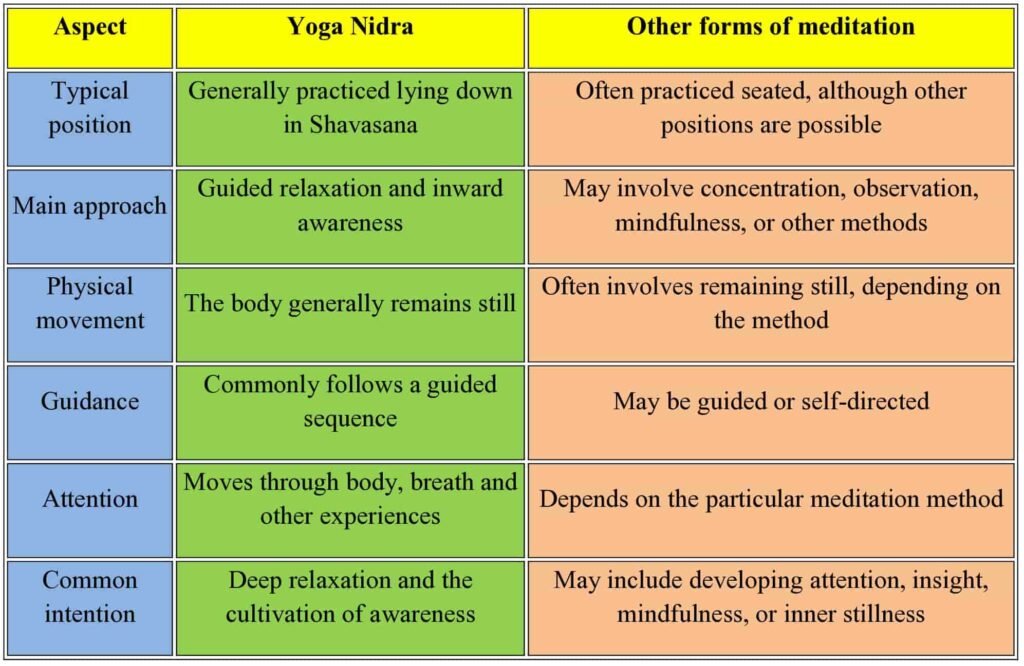
Neither practice needs to be considered superior to the other.
Yoga Nidra may be a comfortable starting point for someone who finds prolonged seated meditation difficult. Other meditation methods, however, offer a wide range of approaches and purposes. The choice between them depends on individual preference and the purpose of the practice.
Frequently Asked Questions About Yoga Nidra
Can Yoga Nidra Help With Sleep?
Yoga Nidra may support relaxation before bedtime and may help some people improve their subjective experience of sleep.
However, it should not be considered a replacement for appropriate assessment or treatment of persistent sleep problems. Difficulty sleeping can have many causes, including lifestyle factors, medical conditions, medication effects and psychological concerns.
If sleep difficulties continue, it is sensible to seek advice from a qualified healthcare professional.
Is Yoga Nidra Helpful for Anxiety?
Some research has explored Yoga Nidra in relation to stress and anxiety, with promising findings in certain groups.
The practice may offer a structured opportunity to relax and observe thoughts without continually engaging with them. Nevertheless, Yoga Nidra is not a substitute for professional mental-health support when anxiety is present, severe or interfering with everyday life.
People who find inward-focused practices uncomfortable should not force themselves to continue. A shorter session, eyes-open practice or guidance from a suitably trained professional may be more appropriate.
Can Yoga Nidra Be a Substitute for Sleep?
No. Yoga Nidra and ordinary sleep are different experiences.
Yoga Nidra can provide a period of guided relaxation, but it cannot reliably replace the restorative functions of adequate sleep. Even if you feel refreshed after a session, your body still needs sufficient regular sleep.
Think of Yoga Nidra as a complementary relaxation practice, not a substitute for your normal sleep schedule.
What is the best time to practice Yoga Nidra?
There is no single best time for everyone.
Some people prefer to practice in the morning or afternoon when they want a period of relaxation without falling asleep. Others prefer a session in the evening as part of their pre-sleep routine.
Choose a time when you can remain undisturbed and feel comfortable. If you want to remain aware throughout the practice, you may find it easier to practice when you are not too sleepy.
What if my mind wanders or I get bored?
The mind may wander during Yoga Nidra. You may find yourself thinking about work, daily responsibilities, or unrelated memories.
Do not treat this as a problem that must be eliminated. Gently bring your attention back to the next instruction when you notice that your mind has wandered.
If you feel bored, simply notice that experience without judging it. The purpose is not to force the mind into silence but to develop a more attentive relationship with what arises.
Are Yoga Nidra and hypnosis the same thing?
No. Yoga Nidra and hypnosis may both involve relaxation and guided attention, but they are not identical practices.
Yoga Nidra follows a yogic framework that commonly includes body awareness, breath observation, Sankalpa (resolve or intention), and other stages of inward attention.
Hypnosis is a different method with its own theories and applications. Although both practices may use relaxation and verbal guidance, they should not be considered interchangeable.
Precautions and Who Should Be Careful
Yoga Nidra is generally a gentle practice, but it should still be approached with awareness of individual needs.
A few precautions are worth keeping in mind:
- Do not practice in a position that causes pain, numbness, or physical discomfort.
- Use appropriate support beneath your head, knees, or other areas when needed.
- If inward attention brings up distressing memories, anxiety or uncomfortable sensations, stop or modify the session. You do not need to force yourself to continue.
- Avoid practicing in a place where falling asleep could create a safety risk.
- People with a history of trauma or experiences of dissociation (a sense of detachment from oneself or one’s surroundings) may benefit from trauma-informed guidance.
- If you have a specific medical or mental-health concern that may affect your practice, seek appropriate professional advice about whether and how to practice.
Yoga Nidra should be understood as a complementary relaxation practice, not as a replacement for medical care, psychological treatment or prescribed medication.
Conclusion: Begin With Relaxation and Develop Awareness
Yoga Nidra offers a structured way to experience deep relaxation, while gradually directing attention inward. Through preparation, rotation of consciousness, breath awareness, Sankalpa, and other stages, the practitioner is invited to observe the body and mind with greater care.
You do not need to achieve a special experience, remain perfectly free from thoughts or complete a long session to begin. Start with a short guided practice, lie down in a comfortable position and allow yourself time to become familiar with the practice.
With regular and appropriate practice, Yoga Nidra may become a valuable part of a broader approach to relaxation, self-awareness, and meditation. Its value lies not in chasing a particular sensation, but in learning to rest, observe, and become more aware.
Disclaimer
This article provides general information about Yoga Nidra, including its technique, practice considerations, and precautions. It is intended for educational purposes and should not be taken as personalized instruction or as a substitute for guidance from a suitably qualified professional.
If you have any health-related concerns about beginning Yoga Nidra, it is wise to speak with your doctor or another suitably qualified professional beforehand. If a practice feels physically or mentally uncomfortable, pause the practice and seek appropriate guidance before continuing.
Yoga Vasundhara does not diagnose, treat, or manage medical conditions through this article. Please use your own judgment about whether a practice is suitable for you and seek professional advice whenever your individual circumstances require it.
About the Author
Yogacharya Dhruv Ji is a yoga teacher and practitioner committed to preserving and sharing the authentic wisdom of traditional Yoga and Kriya Yoga. He received his training in Yoga and Kriya Yoga under the guidance of Swami Birajananda Giri Maharaj, a respected spiritual teacher known for his teachings on yogic philosophy, meditation, and the traditional practices of self-realization.