
Ujjayi Pranayama: Benefits, How to Do It, Mistakes, and What Science Says
Introduction: A Lesson Begins with Listening
Teacher: Before we begin, sit quietly. Let your hands rest on your knees, keep your back comfortably upright, and allow your breathing to continue as it does naturally.
Student: Should I begin Ujjayi now?
Teacher: Not yet. First, notice your ordinary breath. Can you feel where the inhalation begins, how it moves, and when the exhalation ends?
Student: I can feel the air near my nostrils, but I have never paid much attention to the whole movement.
Teacher: Then we have already begun our lesson. A practice of pranayama should not start with ambition. It begins when you become attentive to something that usually happens without your notice.
Ujjayi Pranayama is known for the gentle sound produced as air passes through a slightly narrowed passage in the throat. This sound distinguishes the technique from ordinary breathing and gives the practitioner something specific to observe.
Yet Ujjayi is more than a way of making the breath audible. It belongs to the discipline of Hatha Yoga, in which the regulation of prana is approached through method, preparation, and sustained practice. Its traditional description is found in the Hatha Yoga Pradipika, a Sanskrit text associated with the medieval Hatha Yoga tradition.
To understand Ujjayi properly, we must look at what the classical text actually prescribes, how the technique is taught today, and why a student should learn its subtleties without rushing into advanced practice.
1. Understanding Ujjayi in the Indian Yogic Tradition
The word Ujjayi is commonly understood as “victorious” or “conquering.” Pranayama, meanwhile, is a central discipline of yoga concerned with the regulation of prana through the practice of breathing.
Prana should not simply be treated as another Sanskrit word for air. In Indian yogic thought, it refers to the vital principle associated with living processes. Breath provides an important means of working with prana, but the traditional understanding of prana extends beyond the physical movement of air.
Student: Why, then, do we begin with breathing if the practice concerns prana?
Teacher: Because the breath gives us a practical starting point. We can observe it directly, learn to regulate it, and discover how our own habits affect its movement. The subtler ideas of yoga should not prevent us from learning the practical method carefully.
In Chapter Two of the Hatha Yoga Pradipika, Ujjayi is presented among eight varieties of kumbhaka, a term associated with the retention or containment of the breath. Verses 51–53 describe the mouth being closed, the breath being drawn slowly through both nostrils with a sound, retention of the breath, and subsequent exhalation through the left nostril. The following verse describes circumstances in which the practice may be undertaken.
These instructions matter because they show that the classical account is more specific than the simplified technique often encountered in modern yoga classes.
In contemporary introductory teaching, Ujjayi commonly involves breathing through the nose on both inhalation and exhalation, maintaining a gentle narrowing of the throat and avoiding breath retention. This simple practice helps a student become familiar with the gentle throat action used in Ujjayi. It is an introductory exercise, however, and should not be confused with every detail of the method described in the traditional texts.
Those wishing to study the traditional form of Ujjayi should learn it from an experienced teacher who understands the relevant yogic tradition. Techniques involving breath retention and specific nostril patterns require proper guidance rather than being added to a beginner’s practice without preparation.
2. Preparing the Body and Attention
Teacher: Now let us prepare for the practice. Choose a position in which you can remain still without struggling to support your body.
You may sit in Sukhasana, Siddhasana, or another suitable seated posture. If sitting on the floor causes discomfort, use a stable chair and place your feet firmly on the ground.
Allow the spine to rise naturally. Keep the head balanced above the trunk, the shoulders free from unnecessary tension, and the hands resting comfortably.
Student: Must I sit in Padmasana to practise pranayama properly?
Teacher: No. Do not confuse the name of a posture with the purpose of the posture. For this introductory practice, you need a stable and comfortable seat. If a difficult posture makes you restless or causes pain, it does not help you attend to the breath.
Keep the eyes softly closed if that helps you turn your attention inward. Otherwise, rest your gaze gently in front of you. Notice the movement of the abdomen and chest. Do not deliberately enlarge the breath. Observe a few natural cycles before changing anything.
The traditional emphasis on a stable posture is not an instruction to become rigid. Choose a sitting position in which the body feels balanced and the spine can remain naturally upright. Settle into a position that lets you remain alert and at ease, without allowing physical discomfort to distract you from the breath.
Find a clean, airy place where you can sit without unnecessary disturbance. Allow sufficient time for your food to settle before beginning the practice. There is no need to create elaborate surroundings. In yoga, the value of a practice lies in performing it consistently and understanding its purpose, rather than following outward forms mechanically.
3. Learning the Characteristic Ujjayi Sound
Teacher: Now, observe the breath at the throat. Listen to the soft sound that accompanies the breath. Keep the throat relaxed and allow the sound to develop naturally; there is no need to push the air or tense the neck.
Imagine the gentle whispering quality of a breath that makes a soft “haa” sound. Notice the sensation at the back of the throat, but do not breathe forcefully.
Now close the lips and try to retain only a very slight version of that throat adjustment while breathing through the nose.
Student: I can hear a sound, but my throat feels tight.
Teacher: Then reduce the effort. You are not trying to close the throat. You are learning to regulate the passage of air without making the muscles work unnecessarily hard.
The characteristic sound arises from a gentle narrowing of the glottic passage. The mouth remains closed, and air continues to move through the nostrils. The tongue should not be pressed forcefully against the palate, and the neck should not become rigid.
The sound is a guide, not a measure of achievement. If it becomes harsh, the student may be using excessive effort. If the throat becomes uncomfortable, return to natural breathing and begin again only when comfortable.
Student: How loud should the sound be?
Teacher: Loud enough for you to notice it, but never so loud that producing it becomes the main task. Do not imitate another student’s sound. Different people will produce slightly different qualities of sound.
The useful question is not whether the breath sounds impressive. It is whether you can maintain a smooth flow without disturbing the face, shoulders, or throat.
4. A Gentle Introductory Practice
Follow these steps to learn how Ujjayi produces its soft breathing sound and how to regulate the breath gently at the throat. It does not include the breath retention or nostril-specific exhalation described in the classical method.
Step 1: Establish the seat
Sit in a position you can maintain comfortably. Release any unnecessary tension in the shoulders and observe a few natural breaths before beginning Ujjayi. Keep the mouth closed without clenching the teeth.
Step 2: Inhale through the nose
Draw the breath inward through both nostrils. Introduce a gentle narrowing at the back of the throat, just sufficient to create a soft sound.
Do not pull in a maximum amount of air. Let the inhalation remain within your comfortable capacity.
Step 3: Exhale through the nose
Continue breathing through both nostrils. Maintain the subtle throat adjustment and listen to the sound as the air leaves.
Allow the exhalation to finish without pressing the abdomen inward or forcing out the remaining air.
Step 4: Continue without interruption
Repeat the process for a few comfortable breaths. The sound should remain reasonably even, and the breathing should not become laboured.
Do not impose a fixed count at the beginning. Some students naturally breathe more slowly than others. First establish a smooth and manageable rhythm.
Step 5: Release the technique
After several breaths, stop deliberately producing the sound and return to ordinary breathing. When you finish the breathing exercise, stay seated briefly before moving on to your next activity.After completing the practice, sit for a little while and observe whether your breathing, physical comfort, or mental focus feels different from before.
Student: I can hear the breath more clearly now. Should I make the next inhalation longer?
Teacher: Only if it remains comfortable. Lengthening the breath is not the immediate objective. First learn to recognise when effort begins to interfere with the movement.
A short, clear practice is sufficient for the first lesson. The student should finish feeling comfortable rather than exhausted.
5. What Does the Classical Text Teach?
The Hatha Yoga Pradipika gives us an important reference point for distinguishing traditional Ujjayi from its modern introductory forms.
Verse 51 describes inhalation through both nostrils, with the mouth closed and an audible quality to the breath. Verse 52 directs the practitioner to retain the breath according to the preceding instructions and then exhale through the left nostril. Verse 53 continues with traditional claims concerning the effects of the practice and its use while sitting or moving.
These verses belong to a larger instructional context. Earlier in the chapter, the text discusses pranayama, the role of the guru, and practices involving breath retention and bandhas. Reading the Ujjayi passage in isolation can therefore leave out important context.
Student: If the text describes retention, why are we not holding the breath?
Teacher: Because today you are learning the basic breathing action. Learning one part of a technique does not mean that you are ready for every part of its traditional form.
The word kumbhaka has a specific place in pranayama practice. Breath retention should not be introduced simply because a written description mentions it. It requires appropriate preparation and competent instruction.
Similarly, the text’s statements about bodily effects should be understood as traditional claims expressed within its historical and philosophical framework. They should not automatically be converted into modern medical promises.
A careful student learns both the words of a text and the context in which its instructions are given.
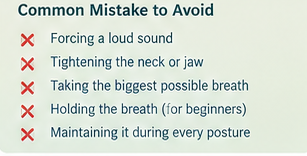
6. Common Errors and Their Correction
Making the throat too narrow
An exaggerated throat adjustment can make the sound harsh and breathing uncomfortable. Reduce the effort until the air can move without a sense of obstruction.
Raising the shoulders
Some students attempt to deepen the breath by lifting the shoulders or tightening the upper chest. Let the shoulders remain quiet and allow the respiratory movement to occur without unnecessary muscular effort.
Forcing the breath to become slow
A slow breath is not automatically a well-regulated breath. If you lengthen each phase beyond your comfortable capacity, the next inhalation may become hurried. Begin with a natural rhythm and allow control to develop gradually.
Trying to imitate a teacher’s sound
The sound is not a performance. Do not strain to reproduce the exact pitch or volume of another person’s breathing.
Adding retention too early
The introductory sequence does not require breath-holding. Do not insert pauses, locks, or prescribed ratios without individual instruction.
Continuing when discomfort appears
If you become dizzy, unusually breathless, or uncomfortable in the throat, stop the exercise and breathe normally. Do not interpret discomfort as evidence that the practice is working.
Teacher: What should you do if you cannot maintain the sound without straining?
Student: I should release the throat adjustment and return to natural breathing.
Teacher: Correct. You can always return to the simpler step. If the breathing becomes strained or uncomfortable, ease off and return to your natural breath. Progress in pranayama comes through patient practice, not by forcing the body.
7. How Should a Student Progress?
A student may begin with only a few comfortable breaths and repeat the introductory practice regularly. The duration should increase only when the technique remains easy and the student can maintain attention without tightening the throat.
Each student develops at a different pace. Let your next step depend on your steadiness, understanding, and guidance from a competent teacher rather than on a fixed number of days or weeks. A teacher should consider the student’s experience, breathing habits, general condition, and ability to follow instructions.
When the basic action becomes familiar, a competent teacher may explain how it relates to a particular Hatha Yoga method or contemporary asana tradition. These applications should be identified clearly rather than blended together as though every school teaches an identical procedure.
In some contemporary yoga practices, Ujjayi is maintained during asana sequences to coordinate breathing and movement. In formal seated pranayama, the focus may be on the breathing technique itself and, in more advanced instruction, on elements such as kumbhaka.
The student should learn what the particular method requires before attempting to combine it with other techniques.
Regular practice is valuable, but repetition alone does not guarantee correct learning. If a student repeats the same strained action every day, the habit may become more established rather than more skilful. Occasional guidance and careful self-observation help keep practice purposeful.
8. Ujjayi and the Wider Discipline of Yoga
Ujjayi should be understood within the wider discipline of yoga rather than as an isolated promise of health or relaxation.
In the Hatha Yoga tradition, pranayama is connected with preparation, steadiness, and the regulation of the breath. The Hatha Yoga Pradipika places great importance on learning under a guru’s instruction. This principle is especially relevant when a practice includes breath retention or other demanding elements.
A gentle Ujjayi exercise may also be used before meditation. The practitioner can listen to the sound for a short period and then release the deliberate technique, allowing attention to rest on natural breathing.
The transition is an option, not a compulsory stage. A student should not assume that Ujjayi itself produces a particular meditative state. Meditation requires its own cultivation of attention.
Other pranayama techniques, such as Nadi Shodhana and Bhramari, have distinct procedures and should be learned on their own terms. Their methods and purposes should not be mixed indiscriminately.
The practice of yoga involves more than learning a series of techniques. A student gradually develops an understanding of each practice, its purpose, and the care with which it should be approached. In Ujjayi, this means learning to work with the breath attentively instead of chasing experiences or collecting techniques.
9. Precautions for Practice
The introductory method should remain gentle and should not include forced breathing or deliberate retention.
People with significant respiratory or cardiovascular conditions, uncontrolled blood pressure, recurrent dizziness, or other relevant health concerns should seek individual guidance before undertaking formal pranayama. A qualified yoga teacher can help adapt instruction, while a healthcare professional can advise on medical suitability when needed.
Stop if you experience chest discomfort, faintness, unusual breathlessness, or persistent irritation in the throat. Seek appropriate medical assessment for concerning symptoms.
Do not use pranayama as a substitute for prescribed treatment. Advanced practices involving kumbhaka and bandhas should be learned from a suitably qualified teacher who understands the particular method being taught.
Conclusion: Practice with Understanding
Student: I understand now that learning Ujjayi is not simply a matter of producing a sound.
Teacher: Yes. The sound helps you recognise the breathing action. Your task is to learn that action without unnecessary effort, understand the method you are following, and respect the limits of your present ability.
Ujjayi Pranayama has a place in the Indian Hatha Yoga tradition, and the Hatha Yoga Pradipika provides a clear classical reference for its distinctive breathing and its traditional method. Modern introductory teaching may simplify certain elements, but it should acknowledge that distinction honestly.
Begin with a stable seat, a gentle throat adjustment, and a breath that remains comfortable. Do not rush into retention or complicated ratios. Learn the foundations, ask questions, and seek direct guidance when the practice moves beyond your experience.
Ujjayi is best approached as a discipline of breath and attention, with its value explored through careful, consistent practice rather than promises of remarkable results. It is to give the student a sound beginning: an understanding of the technique, respect for its traditional context, and a disciplined way to approach further learning.
That is how a breathing practice becomes part of the larger work of yoga—through clarity, patience, and careful instruction.
Traditional source
Haṭha Yoga Pradīpikā, Chapter Two, verses 51–53, Ujjayi section. The classical method described in these verses includes breath retention and exhalation through the left nostril. The continuous, non-retentive breathing sequence presented earlier in this article is an introductory teaching variation, not a verbatim reproduction of the classical procedure.
Disclaimer
This article is intended for educational purposes and introduces a gentle, non-retentive form of Ujjayi breathing. It is not a substitute for personalised instruction from a qualified yoga teacher or for medical advice. Practise within your comfort level and do not force or hold your breath during the introductory exercise. Stop if you experience dizziness, chest discomfort, unusual breathlessness, or other concerning symptoms. If you have an existing health condition or are unsure whether pranayama is suitable for you, consult an appropriate healthcare professional before practising. Advanced techniques involving breath retention or bandhas should be learned under competent, individual guidance.